
After Life
“Episode 6”, Season 3 Episode 6
Requested By
.· Ben ⬩ Salvidrim! ·. on our Discord server. Thank you for supporting the Substack!
What do I know about this series going into it?
It stars Ricky Gervais. I’d seen it advertised on Netflix multiple times before the request but didn’t know anything about it; while clicking through, I saw it’s about a man whose wife dies of cancer and this turns him from happy-go-lucky to bitter-and-cynical.
Sometimes I’m good at avoiding my brain’s instant absorption of the text that describes the show. This is not one of those times.
Recap
It’s an average day, and Tony1 is in his living room with his mother Lisa2 and his unnamed father. The conversation turns to religious matters; his parents believe in God, but he doesn’t. Captions mention an unseen Jill saying “Yeah” during the conversation; my guess is that Jill is Tony’s wife, and possibly a perpetually unseen character.
Zoom out, and Ricky3 is in bed, watching this video recording on his laptop. Tony and his dog visit his wife’s gravestone, then go for a walk in nature.
Later, Joe Wilkinson delivers a package to Ricky’s door. He laments that he’s been dumped, and invites Ricky to go on the pull with him. Ricky turns him down. Ricky then drops by an elderly neighbor and delivers her a copy of the newspaper, because her photograph is on the front page.
Ricky returns to the gravesite to find another man there, whom he identifies as Lisa’s brother. Hmm. I must have switched around the two names in the opening video: Ricky’s wife (the offscreen speaker) must have been named Lisa, and Ricky’s mother (Kerry Godliman) must have been named Jill.
Lisa’s brother doesn’t like Ricky very much, but kinda sorta reassures him that he’s not a totally bad guy.
After the brother leaves, another woman arrives, whose actress I recognize but can’t place. Ricky asks her how she met Stan (I assume her deceased husband). Stan had told her a dirty joke, she recalls, and she didn’t laugh - something she regretted ever since. “How did you meet Lisa?” she asks Ricky. Lisa was an artist, and he had visited her exhibition while penniless; he became enamored with her right away and pretended to want to buy her artwork so that he could talk to her. Ricky goes on to regret how he had teased Lisa (a believer) about there not being an afterlife. He hopes he didn’t succeed in convincing Lisa to fear death.
It’s starting to sound like the description I had of the show - where Ricky turned into a cynical bastard after his wife’s death - wasn’t accurate. He always was a cynical bastard.
The woman sitting next to Ricky - I’m starting to think she’s his mother - doesn’t believe in an afterlife either, nor in angels; in her opinion, angels are humans who sacrifice of themselves to do good works.
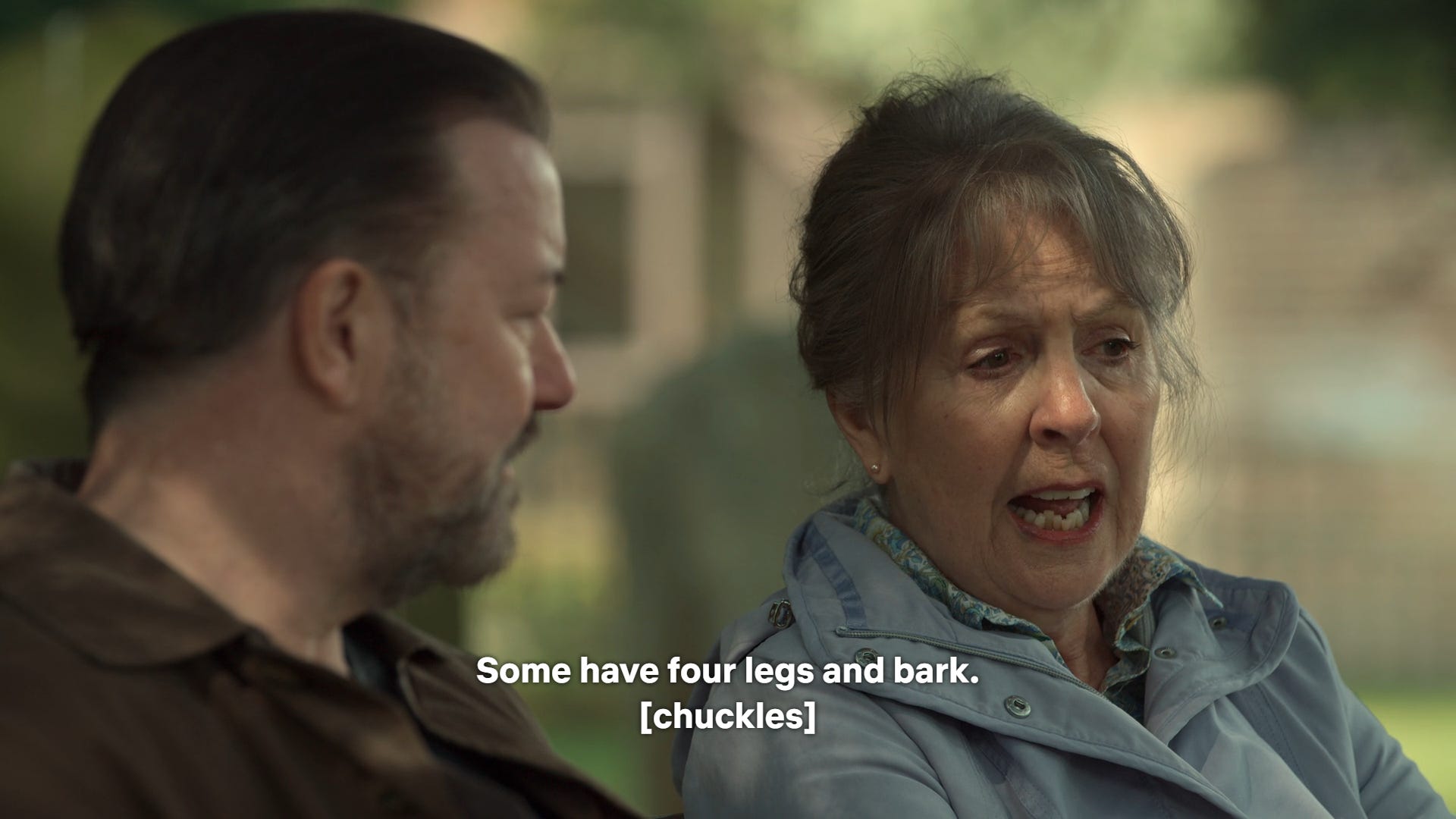
Ricky, I discover, is a reporter, presumably for the newspaper that he had delivered to his neighbor earlier. He interviews two sisters at a children’s hospital: one has cancer, and the other shaved her head in solidarity so they would look the same.
Too coincidentally, the girl with cancer is also named Lisa. When Ricky mentions that it was his wife’s name too, the girl asks where his wife is. Ricky - sorry, Tony, how long have I been calling him Ricky? - lies and says that his wife is at home. Little Lisa asks him to come back every day until she gets better or goes to Heaven. “Do you believe in Heaven?” she asks him. He lies and says yes.
Another video from Kerry Godliman. She is Lisa; I got that completely (and rather embarrassingly) wrong4. She doesn’t want him to worry about her: be happy, be kind, enjoy life, don’t worry about money, be Tony.
Tony shows up at Lisa’s brother’s office and gives him what looks like a check. Lisa’s brother doesn’t want to accept it, but Tony convinces him: "I thought not caring was a superpower, but I’ve realized that caring is a superpower.” Meeting this other Lisa changed everything.
On his way out, Tony gives another person in the office - I’m guessing they all work for the newspaper - another substantial check as a wedding present. And then another check to a third person, not even for a wedding present but just because she’s looking for a new apartment.
This is extremely worrying behavior. Sudden excessive calmness and generosity is not a sign that somebody in emotional distress has recovered. It is more often a sign that their emotional problems no longer worry them because they have come to terms with the decision to commit suicide. The people in the office should check up on Tony’s health immediately, not sitting there dumbstruck and thankful!
Even the old woman to whom he delivered the newspaper earlier finds a roll of bills in her cookie jar, which Tony planted there on his way to use her bathroom5.
Cut to some kind of exercise group, with a half-dozen characters we haven’t seen before.
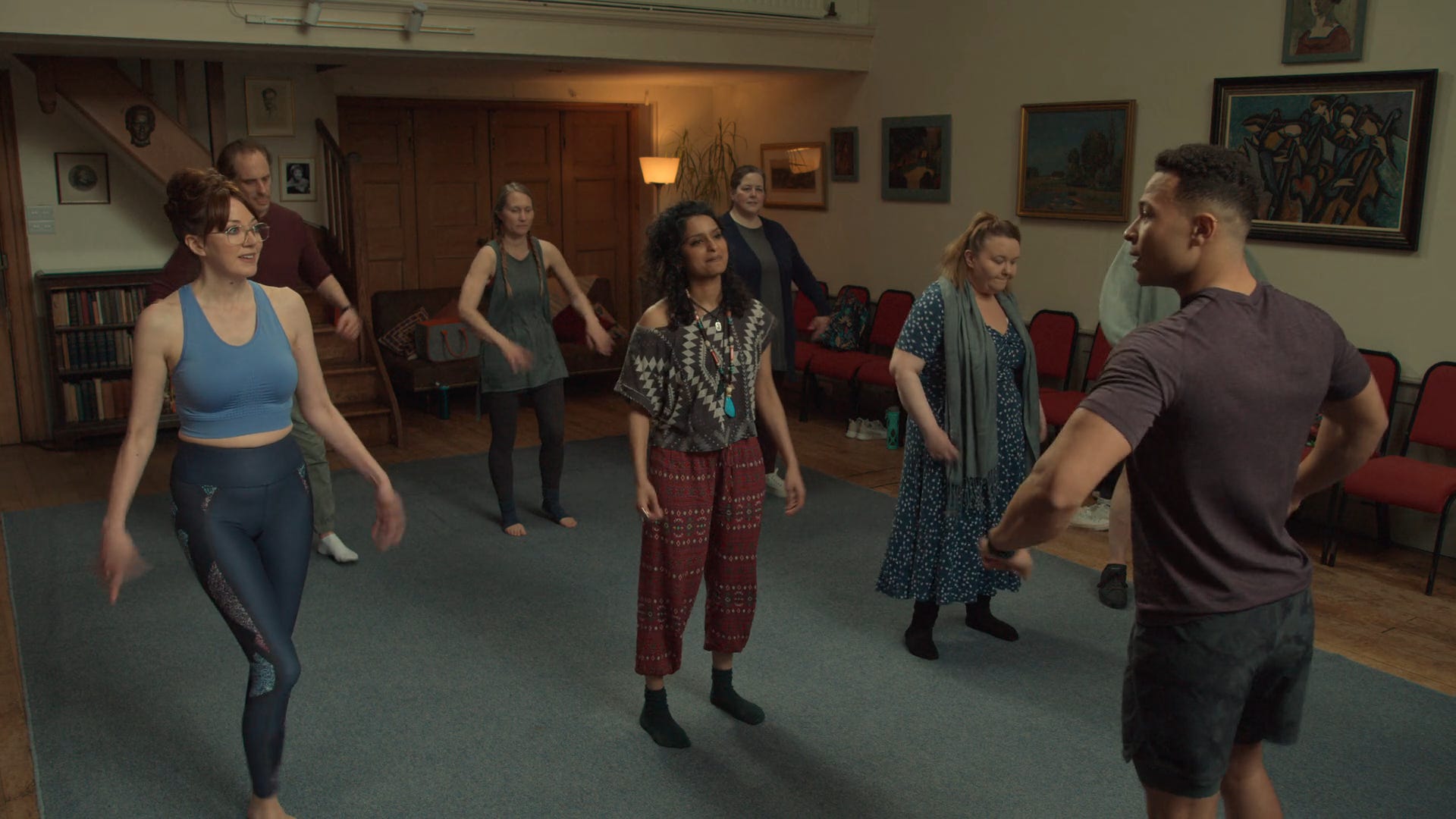
The group leader has everyone laugh out loud to loosen up before the session begins, which most of them do - a fake-sounding, inordinately creepy laugh that inspires something akin to fear in the new girl, Kath. The group leader asks her to laugh along with the others, and she tries a forced giggle but immediately breaks down crying: “I’m so lonely!” The leader kicks her out.
While on yet another walk with his dog6, Tony runs into his friend “Emma”, who introduces him to her friend “Jack”. That is the entirety of the scene.
From there, Tony walks to a village fete, where he meets the woman from the gravesite earlier; this time I recognize her actress as Mel Giedroyc.
The rest of the episode takes place at the fete, and is rather choppy:
“Penny” reads an excerpt from a (badly witten) book.
Tony meets Kath and relates something his father used to say about life being an amusement park ride. You can only go around once, then somebody else needs to get on because they need your seat7.
A strange man of Ricky - sorry, Tony’s acquaintance is desperate to find someone to have sex with, and describes this (and a plethora of personal medical and hygienic issues) to a woman in overly crude terms.
Two jerks wander around the fair messing around with people, including Lisa’s brother and a guy in fake stocks who’s getting tomatoes thrown at him. Some other people finally punch them in the face to get them to leave everyone alone.
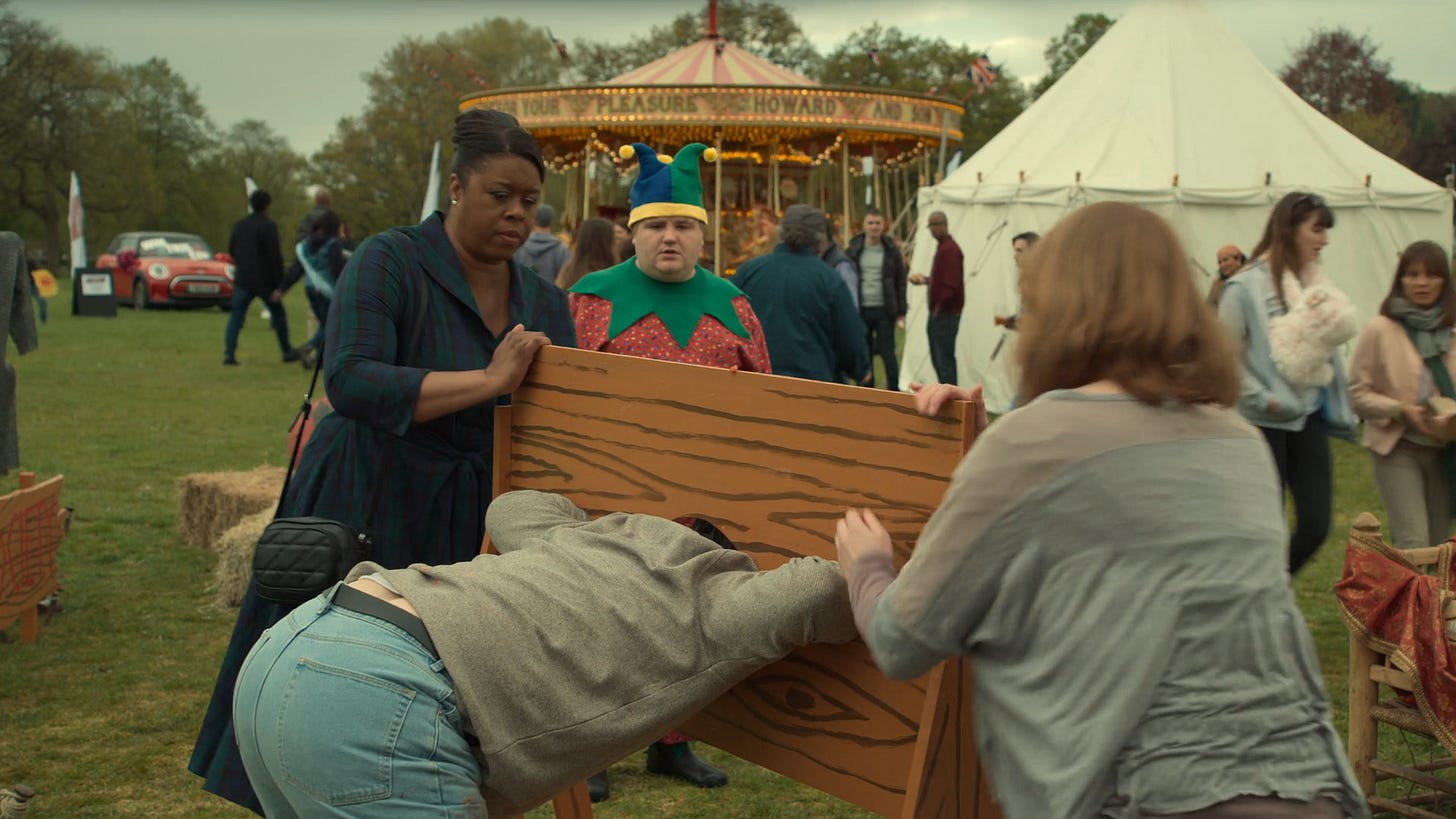
Shouldn’t they make the stocks out of styrofoam or plastic so he can get out in just such an emergency? The guy in the stocks is named “Brian”, and the people who rescued him are his ex-wife and her new lover, Mickey. Brian laments that every time he thinks he’s hit a new low, he goes even lower. A woman asks him out, almost out of pity.
Tony talks to Kath about his dog. Kath adopts a dog as well. Joe Wilkinson, identified in captions as Pat8, stops by.
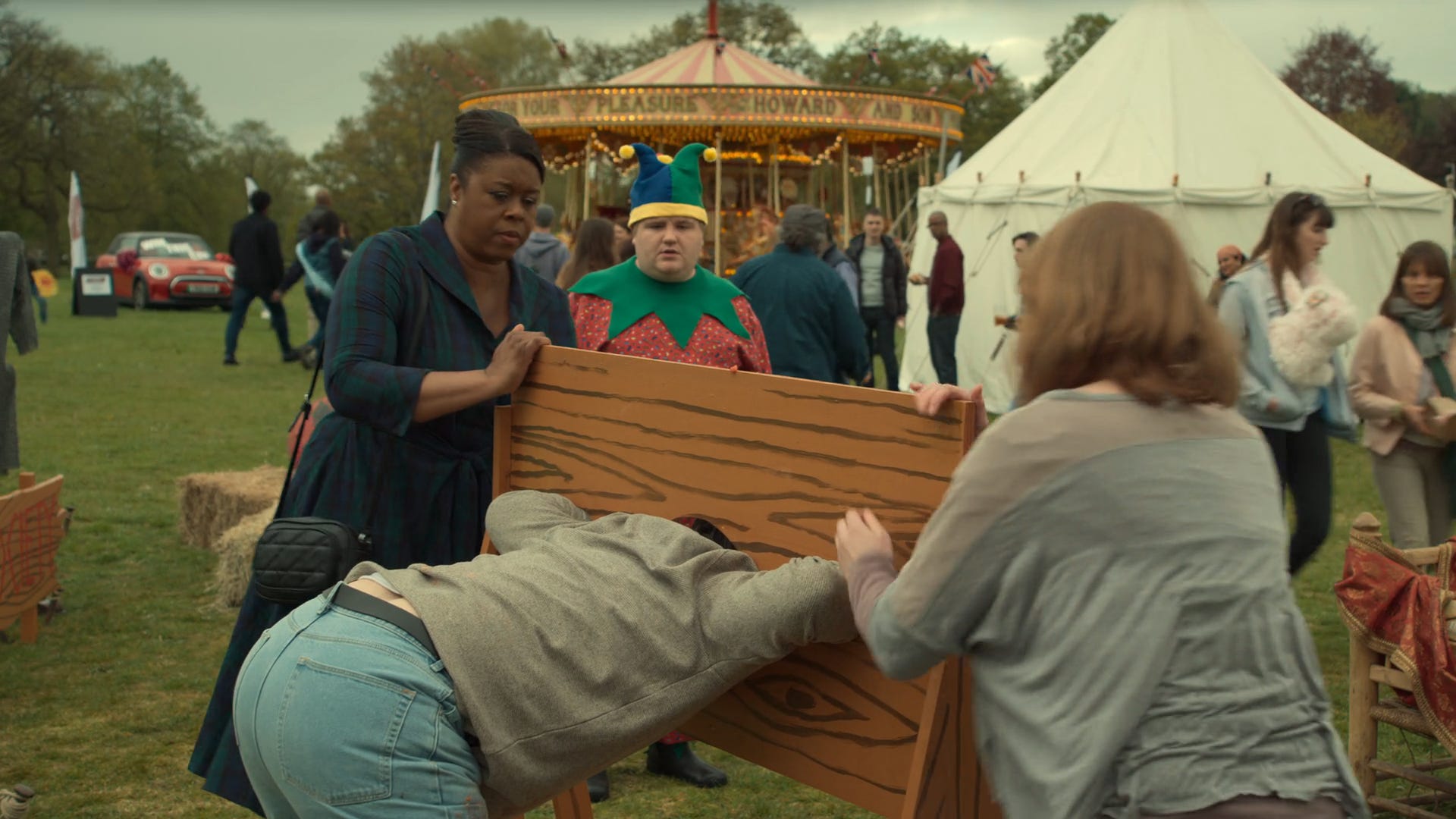
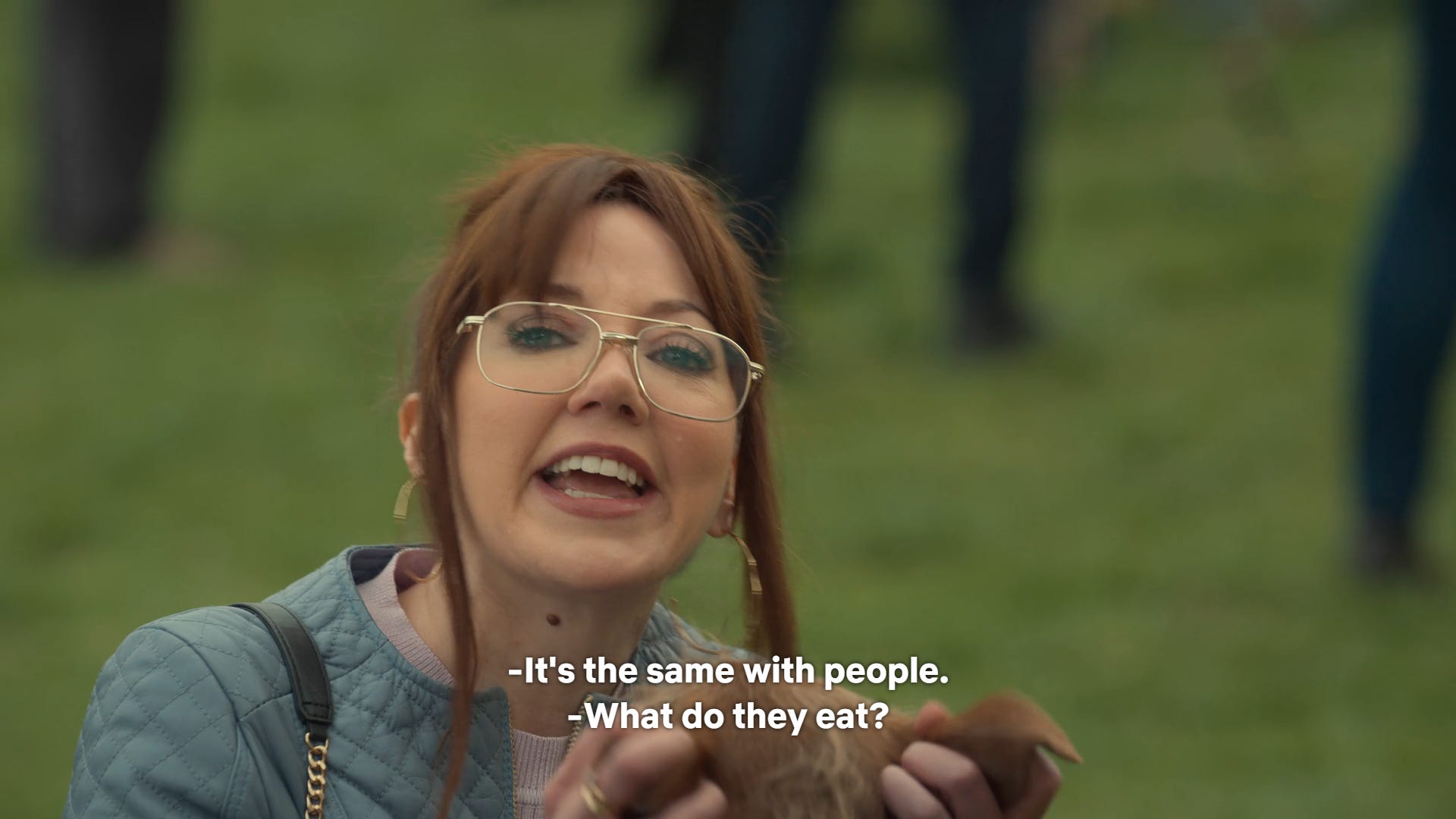
In a montage, we see the couples hitting it off together: Pat and Kath; Rick- uh, Tony’s disgusting friend and the girl he was trying to “pull”; Brian and the pitying woman.
As Tony observes all this, he flashes back to various moments in his life with Lisa. Satisfied with how his friends’ lives are going, he walks off into a field. Lisa appears, holding his hand, then vanishes. Then the dog vanishes9. Then Tony vanishes too.
Lingering questions
Does Tony vanishing at the end imply that he committed suicide? If so, does the fact that the dog vanished first imply that he killed it? If not, does he ever (even decades later) move on and find a new love?
Do any of these budding couples stick together?
Ratings
I evaluate the finale-of-the-week from an angle that its writers never intended: how well it works as an individual episode watched in isolation. This will likely differ greatly from how the episode works in its proper context. And it should go without saying that the following does not apply to the series as a whole, which I have not watched.
The rating system is from 0 to 10, where 5 is considered average for television. These are intended to be measurements, not judgements; a low rating may reflect low quality, but it may also reflect a deliberate choice. For example, a strong character piece may have no plot, or a finale may intentionally provide no closure - neither of which makes an episode bad.
Story: 2/10. There’s no real story in this episode, no plot in the sense of a sequence of events. It’s clearly intended to be a showcase of Gervais’s humanist worldview and not much more.
There appear to be an enormous number of subplots, but the episode does none of them justice. Most of the characters (Pat, Penny, Kath, Brian, Tony’s Disgusting Friend, etc.) get less than half a minute of screentime to wrap up whatever their story was. The episode didn’t need to do that; the main plot could have stood alone as an exploration of Gervais’s worldview as the show’s writer. But instead he went down a long list of minor characters and checked the box next to each one, giving them their 30-60 seconds of wrap-up. The checklist approach to a finale is never very successful.
Compounding that organizational problem is the plot hole I mentioned earlier. The scene where Tony drops off the newspaper at the old lady’s house, then sneaks a roll of bills into her cookie jar when pretending to use her bathroom, takes place before the interview with the cancer patient that gave him his new, generous outlook on life.
Writing: 3/10. Ricky Gervais is an excellent stand-up comic, but subtlety has never been one of his strengths. The Littlest Cancer Patient trope is ham-fisted enough on its own, but let’s start to count the ways Gervais decided to double down on it: 1) By an astonishing coincidence, the girl has the same name as Tony’s wife; 2) Somehow, the experienced journalist didn’t get the name of his interviewees until the very end of the interview; 3) Little Lisa innocently asks where Tony’s wife is, because children in 2022 expect a wife to accompany her husband everywhere he goes; 4) Little Lisa asks Tony if he believes in Heaven, because she’s one of those eight-year-old cancer patients who have delved deeply into the religious/atheist divide in modern Britain.
The lack of subtlety extends to other plot elements as well: Tony’s change of heart is essentially instantaneous; Kath has a breakdown where she just shouts “I’m so lonely” in front of a half-dozen strangers, none of whom express any sympathy for her; women at the fair respond essentially instantly and favorably to the most crude and insulting attempts to pick them up. It genuinely didn’t feel like I was watching a coherent television show, but rather a series of And Then This Happeneds. No justifications wanted or needed.
If anything, the lack of subtlety may have made this episode inadvertently dangerous. Tony’s change of heart was so unsubtle that it resulted in the portrayal, as I said above, of sudden exaggerated generosity in a mourner as a good thing rather than the warning sign that it actually is. I can only hope that nobody who watched this episode overlooks a friend or relative in trouble as a result.
Production: 4/10. The lack of subtlety affects this rating as well. Costumers and editors are usually better at hiding the fact that they’re drawing your attention to a specific character in a scene. I’m only docking a single point for that, though; overall, the production values were run-of-the-mill. Most of the acting was perfectly fine, but I have my doubts about Gervais and Wilkinson’s range as actors. They were basically playing their own comedic personas - so much so that I repeatedly and extensively called the main character “Ricky” in my notes. Gervais is just all too obviously not playing somebody else.
Characterization: 2/10. None of the characters came across as three-dimensional. Even Tony, with whom I spent the vast majority of the runtime, I come away knowing almost nothing about other than he likes walking his dog. His change of heart - if indeed that’s what it was - was so quick and undeveloped that I don’t feel like I understand his character at all. And with the exception of Mel Giedroyc’s character, nobody else was on screen for more than two minutes. (There are shows where the characters are so well-written that within two minutes you get to know them, but this isn’t one of them.)
Accessibility: 6/10. Other than misidentifying Lisa - which is entirely my fault - there was nothing overly complex or confusing about the main plot. Most of the show’s inaccessibility comes from the large number of characters, most of whom are not identified by name because it’s rightly assumed you learned their names in previous episodes.
Closure: 4/10. It’s clear the episode intended to be the close of the series, given Tony’s fadeout at the end. But it’s less clear what makes this episode special. Have the last three seasons involved Tony wallowing in misery until his sudden epiphany here? If so, that would make this episode very satisfying - but it says very bad things about what the rest of the series must have been like. But the opposite (Tony’s been on a gradual journey all along) doesn’t seem to jive with what I just saw and how Tony describes what caused his new outlook.
Do I want to watch the series now?
No. By virtually every measure this episode was decidedly substandard.
Is there a series finale you’d like me to try? Join our Discord or leave a comment below.
Ricky Gervais’s character
Identified in captions, played by Kerry Godliman.
Usually I’ll use the actor’s name only if I haven’t yet learned the character’s name. On those occasions when I have learned the character’s name and still use the actor’s name by accident, I usually fix it during the edit. But in this case I’m going to leave the Ricky/Tony error intact each time it happens. The reason will become clear.
I had assumed in the opening video, based on posture and proximity, that she was married to Tony’s father. This assumption ended up so deep-rooted that even presented twice with evidence to the contrary I failed to overturn it.
This is a continuity error. The great realization, as described to his brother-in-law, came after that scene.
His job must have incredibly cushy benefits.
Tony’s father seems unaware that the human population is increasing.
For a moment I thought: whoa, the dog was dead all along? Then I remembered that Kath interacted with it during the fair.