
Deadwood
“Tell Him Something Pretty”, Season 3 Episode 12

Requested By
What do I know about this series going into it?
I know it’s a Western, but I don’t know whether it’s modern-day or not. The description (from which I once again couldn’t avert my eyes in time) says it’s 1876. I seem to recall it’s based on a movie. Several podcasts I listen to have said it was very good.
Previously On
Seth Bullock1 isn’t happy to have been called back from “Sturgis”. Somebody wants somebody else killed, and that person is in fact killed. Hawkeye is on his way. There’s a coming combat. Hearst is causing trouble. A woman wants her child. Trixie shoots Hearst in the shoulder and begs someone to kill her lest his wrath come down on all of them. A man says goodbye to his wife and daughter. Edward James Olmos orders a Chinese man to bring all of his fellow countrymen to Deadwood.
Recap
Opening credits show generic Western scenes to generic Western music: running horses, panning for gold, playing cards, pouring alcohol and pouring gold dust.
Hearst wakes up to knocking on the door. It’s a Mr. Utter: The casket Hearst ordered with his name on it has arrived, and there’s a body inside it. Utter isn’t happy with how Hearst is speaking to him, and threatens Hearst, but Hearst doesn’t care, threatening him back.
A man discusses the situation with a woman named Claudia; he talks in excessively flowery language, which is explained once he mentions being a theater man. He says that the “camp” – I assume Deadwood – is in danger, because Hearst is murderous and the coming election will be nullified.
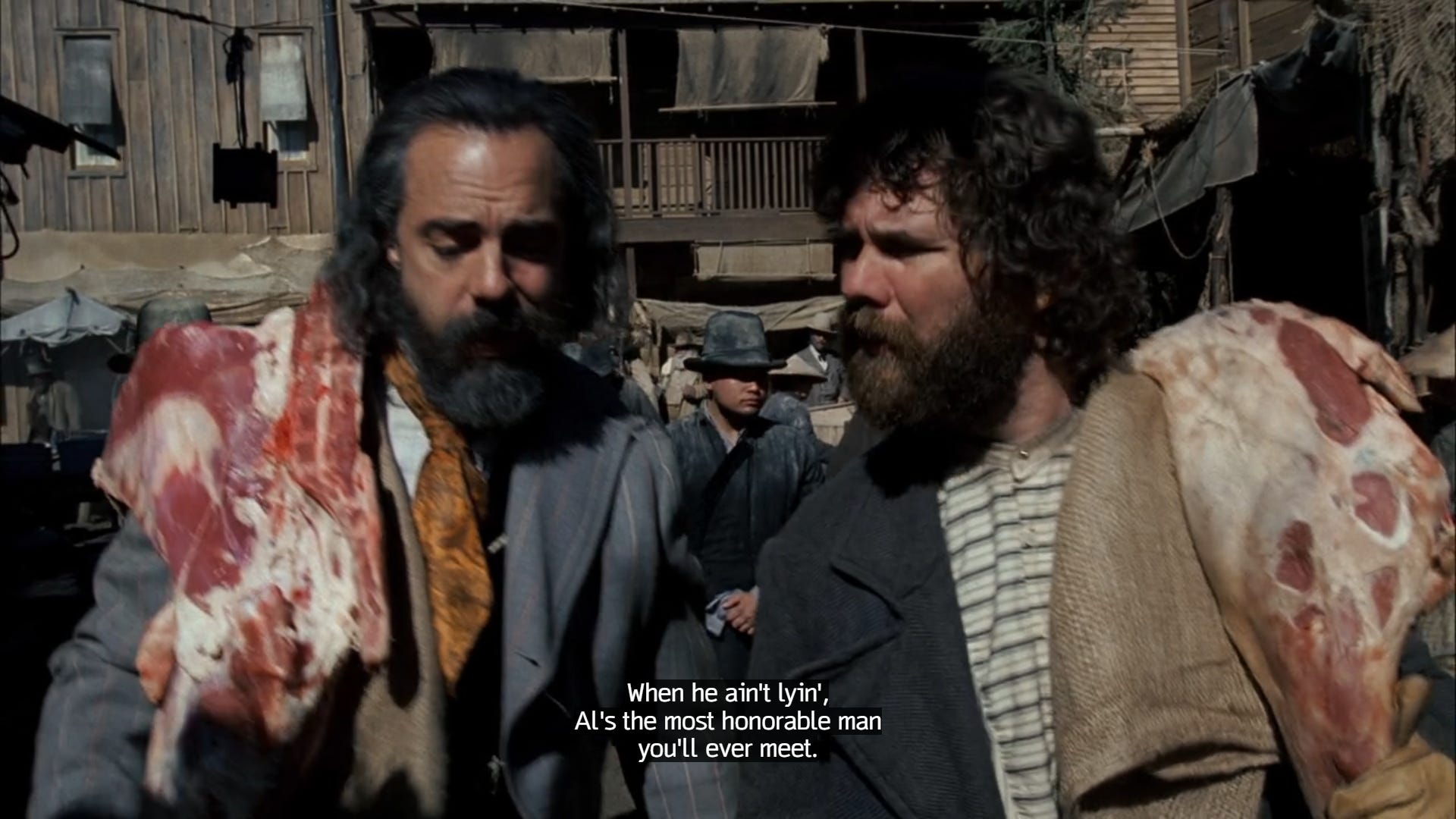
Whoever this Al Swearengen is, he’s Hearst’s enemy. He has a group of people camped outside the town, hidden, so that they can attack by surprise when called upon.
A woman brushing her young daughter Sofia’s hair talks about how she needs to sell her land because that’s the only way that Hearst will allow her to stay in Deadwood. The daughter wants to stay so she can see “Mr. Ellsworth”.
In the next scene, the same woman is signing a contract selling her land to Hearst. She is quickly identified as Mrs. Ellsworth, which raises a few questions.2 Hearst signs the contract, but isn’t happy about the precautions she demands to make sure the gold he pays her is pure and genuine and actually deposited in the bank. She says the precautions are warranted, given people tend to die around Hearst, and can’t help but call him vicious and grotesque to his face. He reacts angrily, then regains control and pays the insult forward by insulting the Judaism of one of his minions, a Mr. Star. He then also comments on Ellsworth’s perfume. A Mr. Bullock, furious, calls Hearst a bully.
Later, a man who claims to have hallucinations visits Mr. Hearst. Hearst hands the man a letter to deliver.
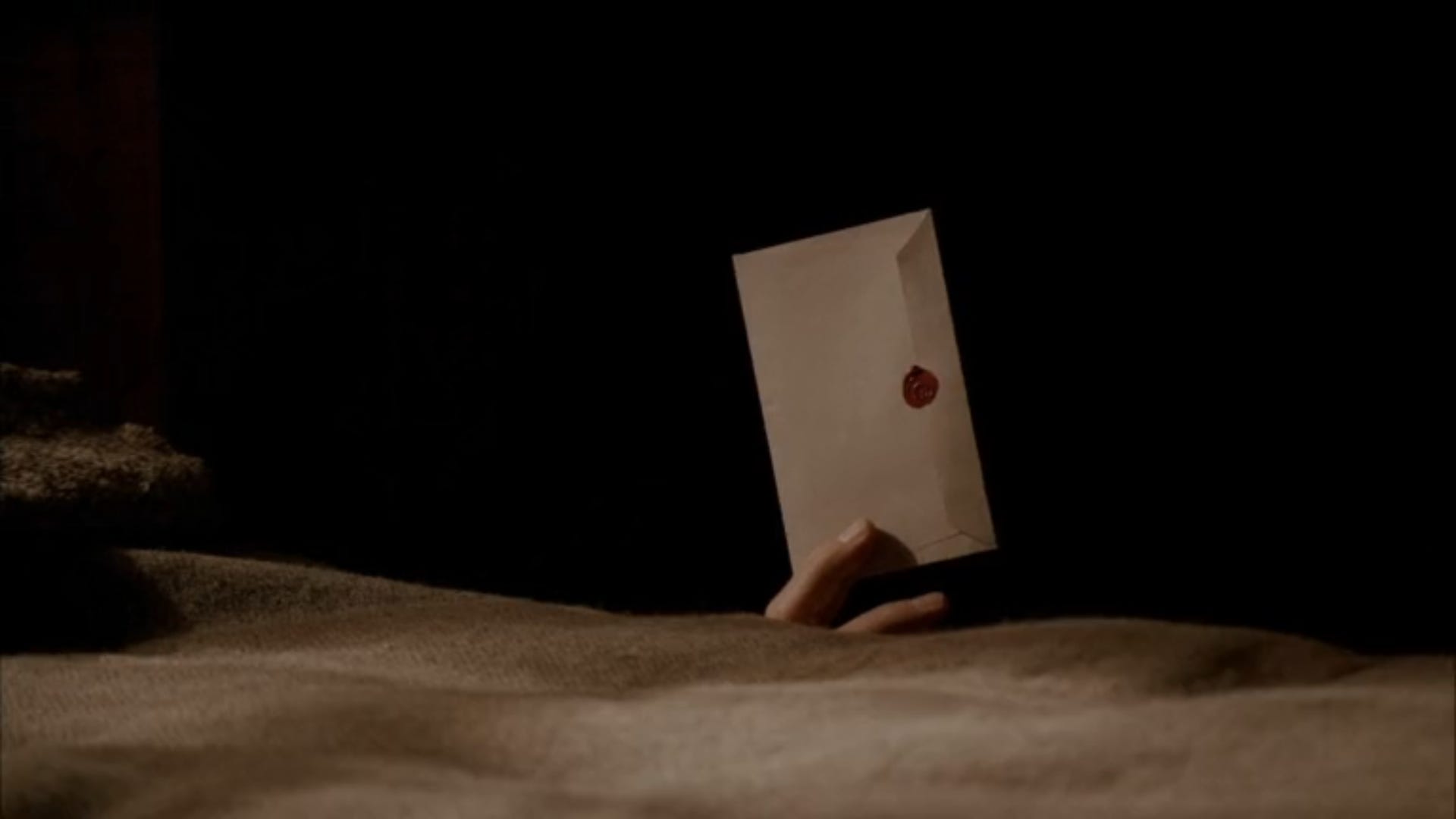
Elsewhere, “Harry” is running for sheriff. His friend Rutherford3 shows him a fire engine.
The deliveryman brings the letter to Edward James Olmos. The deliveryman is named “EB”, while Edward James Olmos is the Al Swearengen mentioned earlier. EB initially assumes that the letter orders Swearengen to put him to death for his part in getting Hearst shot (which we saw in the Previously), but in fact Hearst has ordered Al only to kill the shooter, Trixie.
“Joanie Stubbs” comes to see “Cy Somethingorother”4. She thanks him for saving her life. They have some complex history together, but unfortunately this scene doesn’t give me enough details to understand it.
Al Swearengen doesn’t want to kill Trixie, so he orders a subordinate to kill “Jen” instead. I don’t know who Jen is, but she might be the same person as a “Janine” who briefly appeared in the Cy Somethingorother scene. Al’s plan is to pretend Jen’s dead body is that of Trixie, reasoning that Hearst can’t tell one woman from another as long as they both have breasts.
Mr. Star comes home to find Trixie getting dressed and preparing to go out and vote in the election. He throws her out because she’d “rather die than live with” him, then breaks down sobbing. Immediately, there’s a hesitant knock on the door: Trixie is back, she’d rather stay with him than vote (what?), and sobs in his arms.
I don’t entirely understand what the vote is about. There’s an election for sheriff at the same time as some sort of referendum on opium and probably other offices as well. There was a reference to Trixie getting a blow job in exchange for voting twice, which makes no sense.5
Al’s hitman enters Jen’s room, pulling out the knife while she’s not looking. He rambles to her about how the wall has ants in it, and every ant has its job - trying to keep her distracted while he builds up the confidence to stab her – but ultimately can’t go through with it.
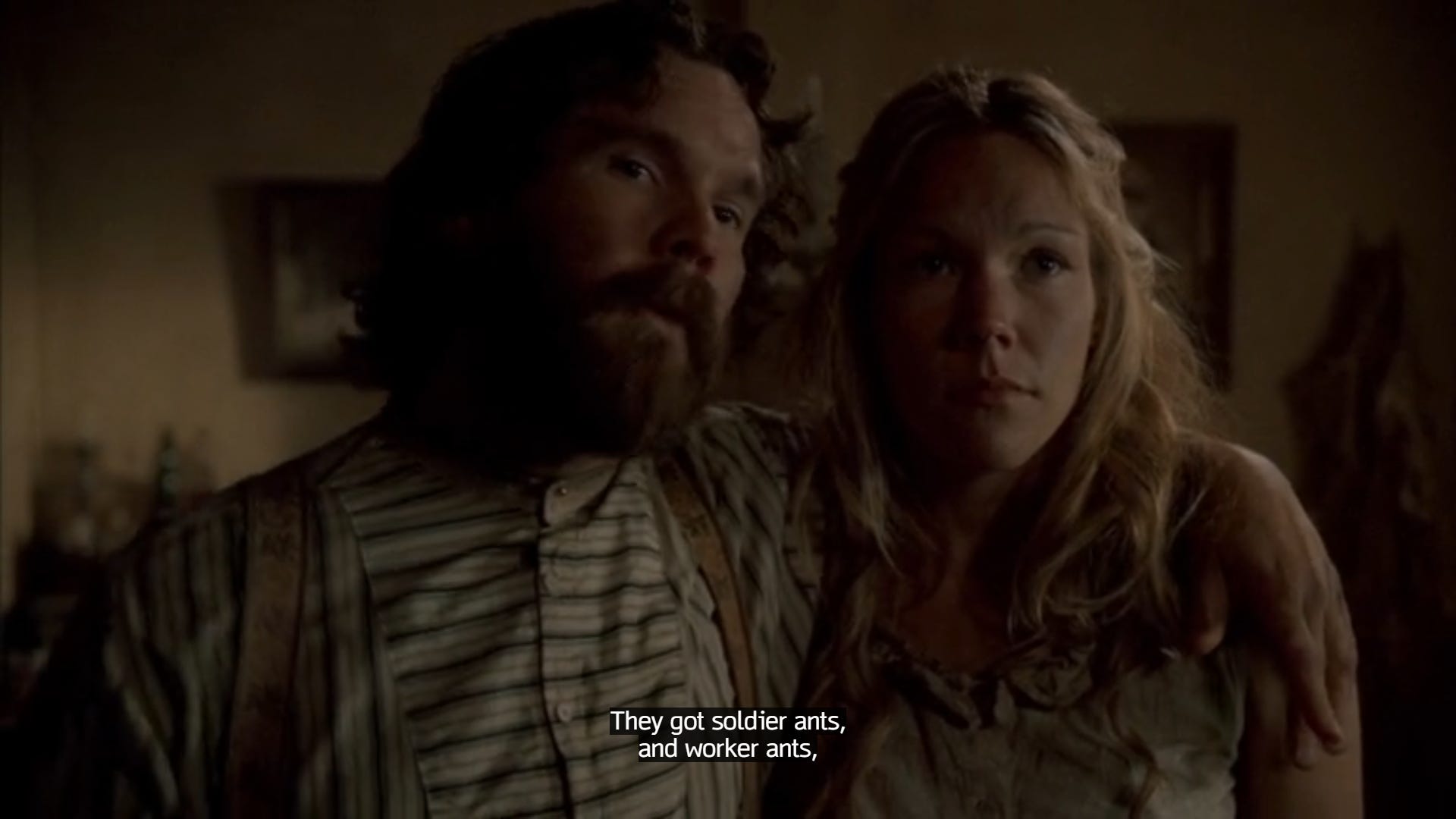
He chickens out and leaves, to find that Al is waiting outside; it turns out the hitman, Johnny, has always loved Jen.6
Al demands that Johnny give him the knife, but he refuses: he’s willing to die to stop Al from killing her. So Al leaves, ordering a subordinate to knock Johnny unconscious and prevent Jen from leaving while he goes to get another knife.
I learn a bit more about the election: there are three candidates running, though they might not be running for the same office. One is Harry Manning, one is “Mr. Bullock”7, and the last is Mr. Star. I still don’t understand why this election has everybody worked up.
Meanwhile, at the polls:
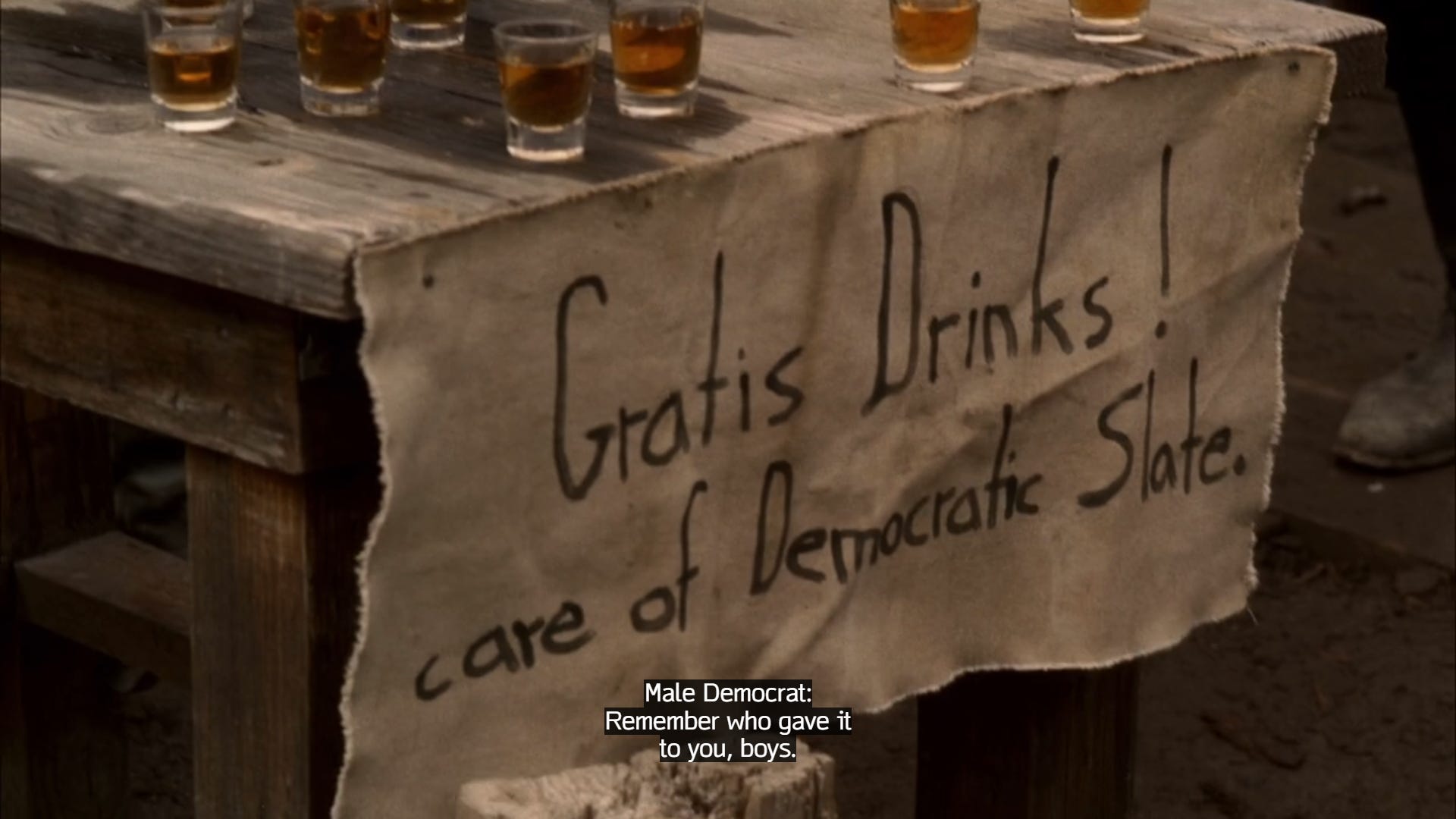
A black man waiting in line is heckled by the white voters – slurs flying, claims that all the white people were ahead of him in line, etc. – but he’s defended by the sheriff and another guy quoting the 15th amendment. He even wants to leave to avoid trouble, but the sheriff orders him to stay and vote. The black man proceeds towards the voting booth, pushing a dying-or-dead white guy on a stretcher-bed so he can vote in both their names; this is when I realize we briefly saw these two earlier, though I still know nothing about them.
Al meets with Hawkeye, the leader of the mercenaries he hired. They’ve only got 18 people (well, 17 and a short guy with a knife). Al is not thrilled.
Meanwhile, Stubbs comes to see “Jane”, who is lying in bed, drunk or hungover. She’s angry at Stubbs for some reason, but Stubbs mollifies her and they embrace.
Hearst orders Star to tell Al that he wants to verify Trixie’s death visually. So Al goes into an office and bravely tells Hearst to go to hell: Trixie took good care of me when I was sick, and I’m not going to kill her! I’m not going to do something so heartless that will have everybody in Deadwood asking me “How could you?!” for an entire generation! The box on the shelf, to whom Al is actually saying all this, fails to respond.
Mr. Utter from earlier, who I thought was the sheriff in the voting scene, is actually his deputy or some such. The sheriff is running for reelection, and Star is on his side in the election in some way.
The theater guy, Mr. Langrishe, comes to visit Hearst. Their conversation is heavy in metaphor and I understand not one word. Hearst is planning to leave town to return to his silver and copper mine, once the election is over. So why does he care about the election if he doesn’t even plan on living here anymore?
Al sends a subordinate to put Jen’s body in a casket, after Trixie replaces her clothing so she looks like her. Johnny, meanwhile, has woken up, shouting expletives but unable to interfere because he’s tied up.
In the meantime, Harry Manning is winning the election by a landslide. We saw Manning earlier, and I’m pretty sure he wasn’t the guy in the scene with Utter, so I think Bullock is the current sheriff.
Al tells his subordinates the plan: We pretend it was Trixie. If Hearst figures it out, I’ll try to stab him (Al has apparently sworn never to touch a gun). After I fail and die – he doesn’t even entertain the idea that he’ll succeed - you all pretend you had no involvement in the lie, that I did this on my own.
Cy Somethingorother stabs a guy named Leon. No idea why.
Hearst and a load of armed men come into Al’s brothel. Hearst rants at Bullock (I was right, he’s the current sheriff) about something I don’t understand, then accompanies Al into the room. Al opens the casket. There’s a tense moment, while Al tries and fails to act nonchalantly. Hearst checks her pulse. Is Hearst going to buy it?
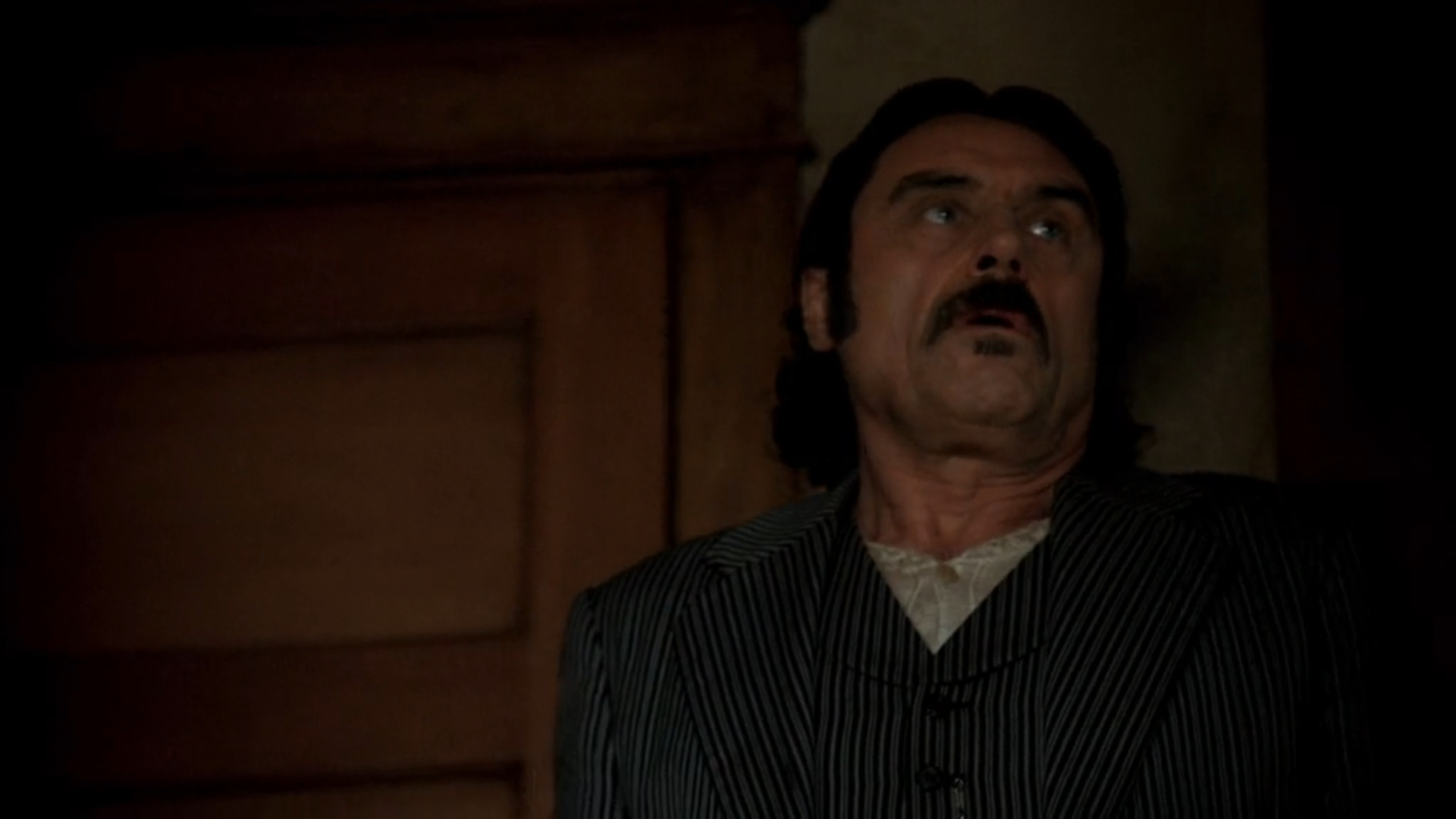
He buys it, and leaves. Either that, or he noticed Al’s intention to attack him and will make up for it by killing Al and the real Trixie later, when they’re not expecting it.
Having killed Leon, Cy pulls out a gun, planning to kill Hearst as the latter rides by in his carriage. But the sheriff is outside, talking to Hearst on the carriage, warning the latter to get out of town because he’s sick of the dead bodies following him around.8 This saves Hearst’s life, as Cy can’t shoot him in front of the law. And Hearst leaves Deadwood for good.
Al respects Jen enough to clean up the blood from the murder himself rather than delegating it. Johnny, now untied, asks Al if Jen suffered. But Al can’t give him the comfort he seeks.
Unresolved questions
It’s still daytime. Are those the final results of the election?
Does Hearst ever come back?
How much independence does Al now have from Hearst?
What are the 18 mercenaries Al hired going to do?
Ratings
These ratings evaluate the finale-of-the-week from an angle that its writers never intended: how well it works as an individual episode watched in isolation. The analysis accompanying each rating is written from that point of view as well.
The ratings do not necessarily apply to the episode if it is watched in the proper context. And it should go without saying that none of them apply to the series as a whole, which I have not watched.
Story: 8/10. The episode clearly contained a complex plot with many interacting parts. You had Hearsts’s demand for revenge against Trixie; Swearengen’s desperate attempt to disobey and rebel, tempered by his own cowardice; whatever Cy Somethingorother was up to; numerous side characters drawn into the stories of those four in various ways that I didn’t understand; and the election running underneath it all.
Only the Hearst/Swearengen/Trixie plotline was truly clear. But in general I give the episode the benefit of the doubt: if events are happening, and they aren’t clearly nonsensical, and the parts that I understood were handled well, then I assume the show knows what it’s doing. I do have some questions as to why the election was so important to Hearst, if he was permanently leaving town anyway, but I assume that’s a failing on my part rather than the writers’.
Writing: 9/10. Excellent dialogue, with attention paid even to the tiny nuances, such as Al’s underconfidence in saying outright that his attempt to stab Hearst will fail.
I want to highlight two scenes in particular:
The scene between Johnny and Trixie was excellently written, where he rambles on about ants, trying to keep her distracted while simultaneously apologizing to her for what he’s about to do while simultaneously not revealing what it is he’s about to do, and then losing his confidence. It was a perfect character moment.
Al Swearengen telling off the Hearst Box was a deep and hard look into Al’s soul and how he wishes he had the confidence to face down Hearst properly but can’t escape his subordinate position. The decision of the writers to leave the mercenary plot hanging fits this very neatly: he can go just far enough to pretend to threaten Hearst but doesn’t have the guts to follow through with it.
I was told in advance that this show had the same creator as last week’s John from Cincinnati, and while that isn’t immediately evident, it shines through in the conversations held by the theater guy, Mr. Langrishe. He clearly comes from the same planet that John did.
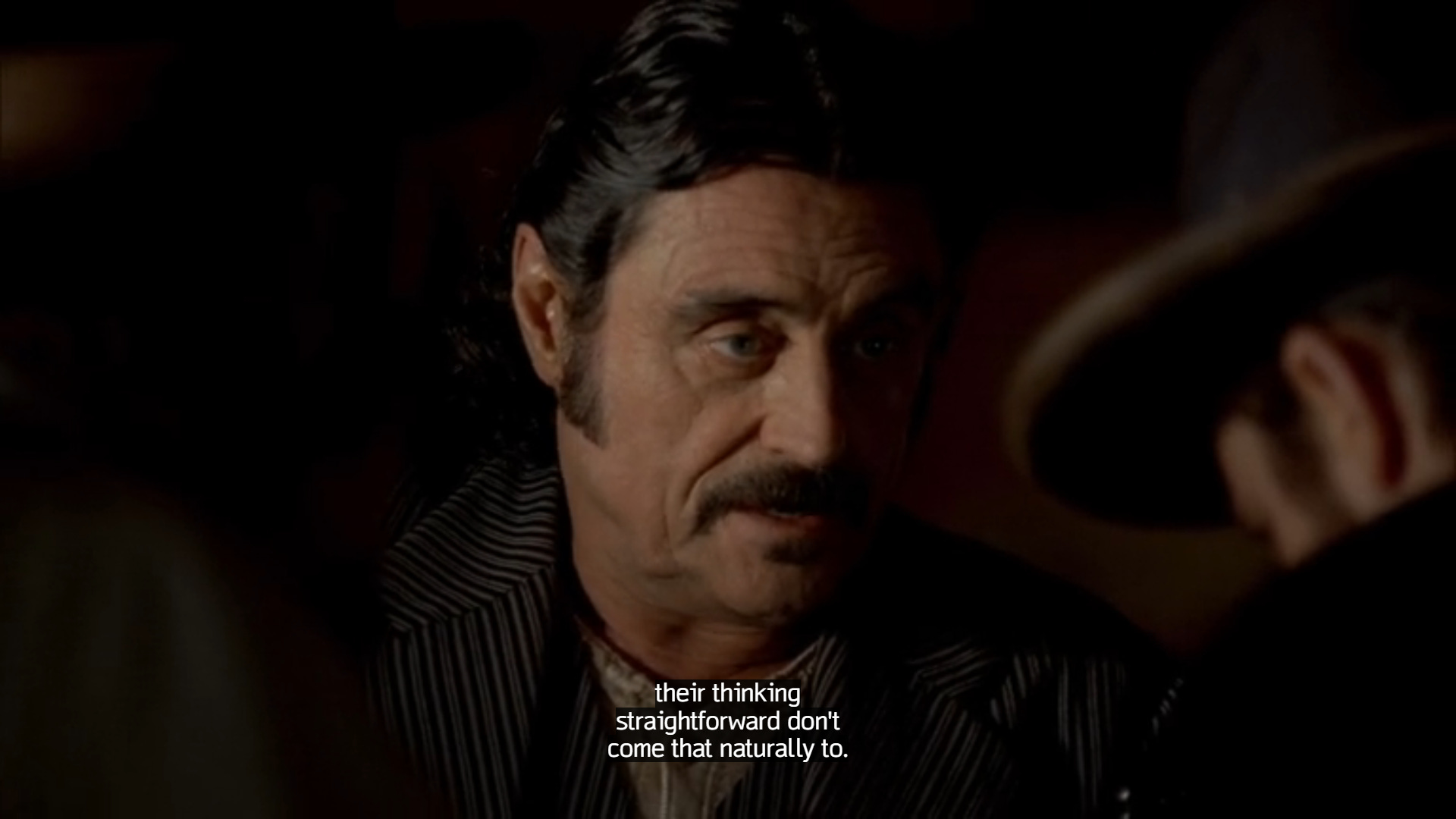
Production: 10/10. The world of 1870s Deadwood was extremely well realized, set design and costuming and all.
And the director clearly knew what he was doing. I praised the writing of the Hearst Box scene above, but there’s an unexpected directorial decision there that I want to highlight. Your run-of-the-mill director would have had Al give his entire rant to the camera, then reveal that he’s talking to a box only at the very end. It’s a classic trope for a good reason: it works very well.9
But the director of “Tell Him Something Pretty” didn’t play it straight. He showed us the box at the very beginning of the scene. He wanted us to know, while watching Al’s rant, that he doesn’t have the guts to say it Hearst’s face. The director recognized that the point of the scene is to show us who Al really is, deep inside. Revealing the box as a surprise at the end of the scene must have been tempting, but it would have detracted from that far more important goal. Kudos.
Which brings us to the acting. You can’t make a decision like that unless you have an actor who can pull off the scene properly – and Edward James Olmos excelled. I’ll go into this below, under Characterization, but I am fascinated by Al and want to know all about him. Even in an extensive lineup of good actors (Trixie and Janine and Cy and Hearst and Utter), he stands out. But overall there’s not a weak link in this cast.10
Characterization: 10/10. Al Swearengen alone has enough dimension for a dozen main characters. I want to know why he’s (apparently) sworn off ever touching a gun. I want to explore his sense of honor and morality. I want to learn what evil things he’s done and explore the various ways he takes personal responsibility for doing them. I want to learn where else, aside from killing Trixie, he draws the line.
Hearst was also a fascinating, three-dimensional character. Yes, he’s evil. Yes, he’s murderous. Yes, he demands revenge. But he also exercises control; he is neither petty nor goaded by insult nor prone to rash action. That makes him far more dangerous, and far more interesting.
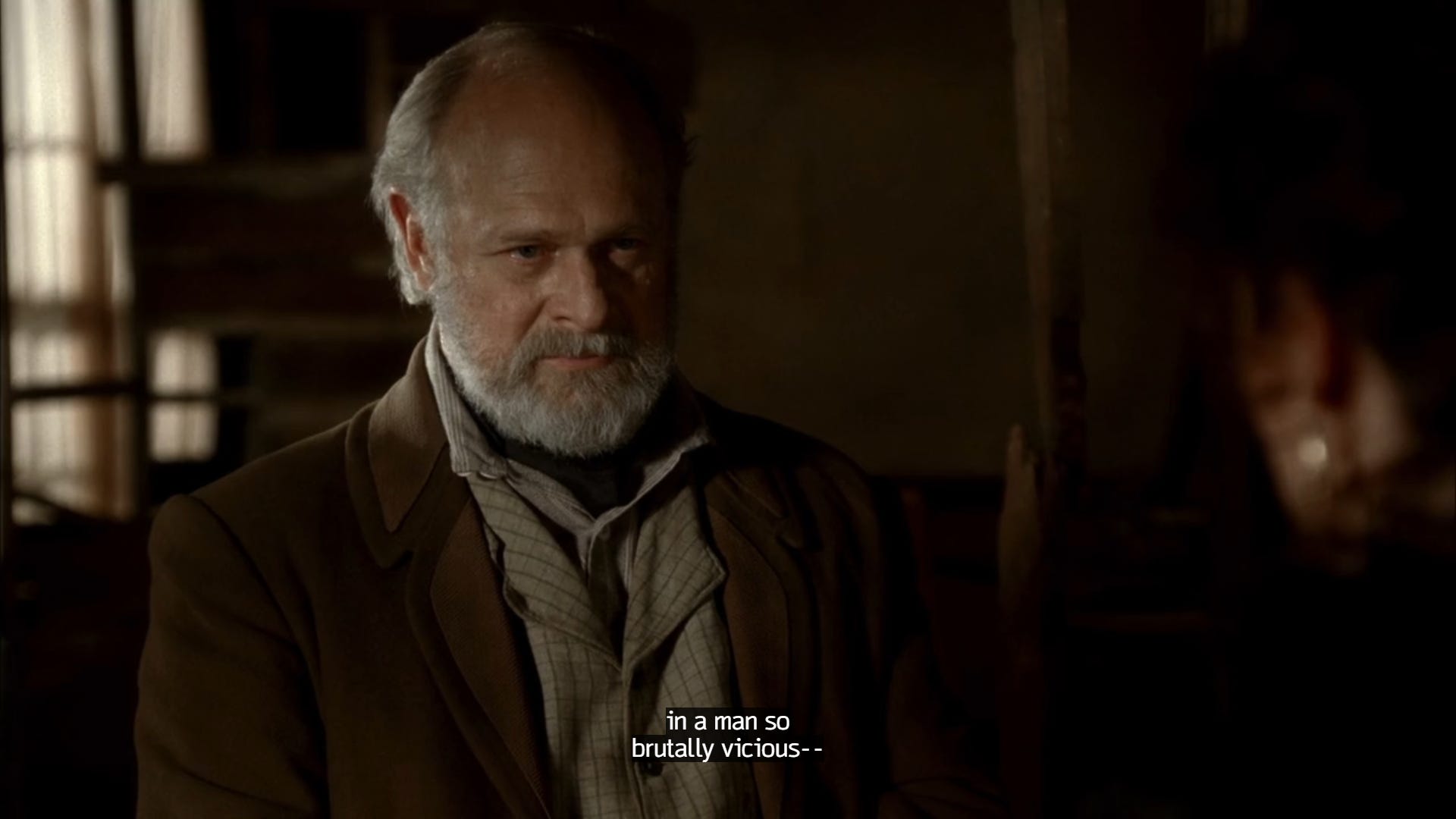
I wasn’t able to get as deep a read on most of the other characters, as I was focused on trying to figure out the plot. But it’s clearly all there, waiting for me to unpack it should I start the series from the beginning. Even a minor character like Jen played the ant scene perfectly - not expressing as much confusion as a more independent character would, given her submissive social status.
Accessibility: 4/10. By the end I was able to differentiate most of the characters by face, and I understood the main plotline (Hearst/Al/Trixie/Johnny) well enough. But everything else was a blur. I don’t know what Stubbs and Jane were up to. I don’t know what was going on with Mrs. Ellsworth. And I didn’t have a clue what was happening in the election. Deadwood is clearly heavily serialized, and this episode wasn’t designed to be watched in isolation.
Closure: 6/10. I’m less certain about this rating than usual. Hearst, the primary antagonist, has left town seemingly for good. That sounds like closure to me. But it didn’t feel like he left town because the good guys – if there are any good guys in this universe – ran him off or anything. And there are still many dangling plotlines: what are Al’s mercenaries going to do now that they don’t have a target? Are the election results final, and how will this affect the town? What exactly is Cy up to? Something got resolved here but I’m willing to bet the fans weren’t 100% satisfied with the ending.
Do I want to watch the series now?
I’m not sure. As I’ve said in other reviews, I’m a sucker for high-quality historical and costume dramas with ensemble casts of characters who pinball off of each other in unexpected ways. That sounds perfect, right? But at the same time I’m not a fan of gratuitous swearing, which this show has in spades, nor of the gratuitous nudity for which HBO is famous (Cy accidentally pulling down Janine’s corset as they struggled was definitely gratuitous). So Deadwood is both made for me and not really for me, simultaneously.
All character names in the Previously were learned from the captions.
If Sofia is her daughter, why does she call her father Mr. Ellsworth? Or is he her stepfather? What does it mean to “see him”? Is he dead, and she’s referring to visiting his grave?
Name given in captions.
The name was given but I didn’t catch it.
In hindsight, I was being really stupid when I wrote this in my notes. Women didn’t have the vote, of course, in 1876, and Trixie is a prostitute. She is giving people blowjobs in exchange for them changing their vote, which is why Star, her partner, was so angry.
What can I say, when you’re trying to absorb a dozen different plotlines at once you’ll thoroughly screw up at least one or two of them.
To clarify, this is a surprise only to me, not to the characters.
Only upon rereading my notes did I realize that Bullock had appeared earlier, in the contract-signing scene; I had forgotten.
Why didn’t he arrest Al for committing the actual murder?
Almost too well; at this point one already knows to expect it. Any time a character talks to the camera extensively we’re already thinking to ourselves, “Okay, who’s he really talking to?”
With the sole exception of the child actress playing Sofia, who was just reading lines, but I won’t dock a point for that; good child actors are very hard to find.
Watch the series. Watch it twice. It is the best writing you will ever find short of Shakespeare.