
Devilman Crybaby
“Crybaby”, Season 1 Episode 10
Requested By
mllebienvenu on Reddit
What do I know about this series going into it?
It’s anime; I had never heard of it prior to the request. I caught an involuntary glimpse of the name “Ryo” while clicking through to it.
Recap
The opening credits are in heavily stylized black and white. There’s a statue of Batman; a beating heart; a bunch of people giving Nazi salutes; a naked woman collecting black goo and embracing a man who turns out to be a gargoyle; meteors hitting the Earth; Rorschach tests; a spider; and another gargoyle. They conclude on a screenshot from Street Fighter.
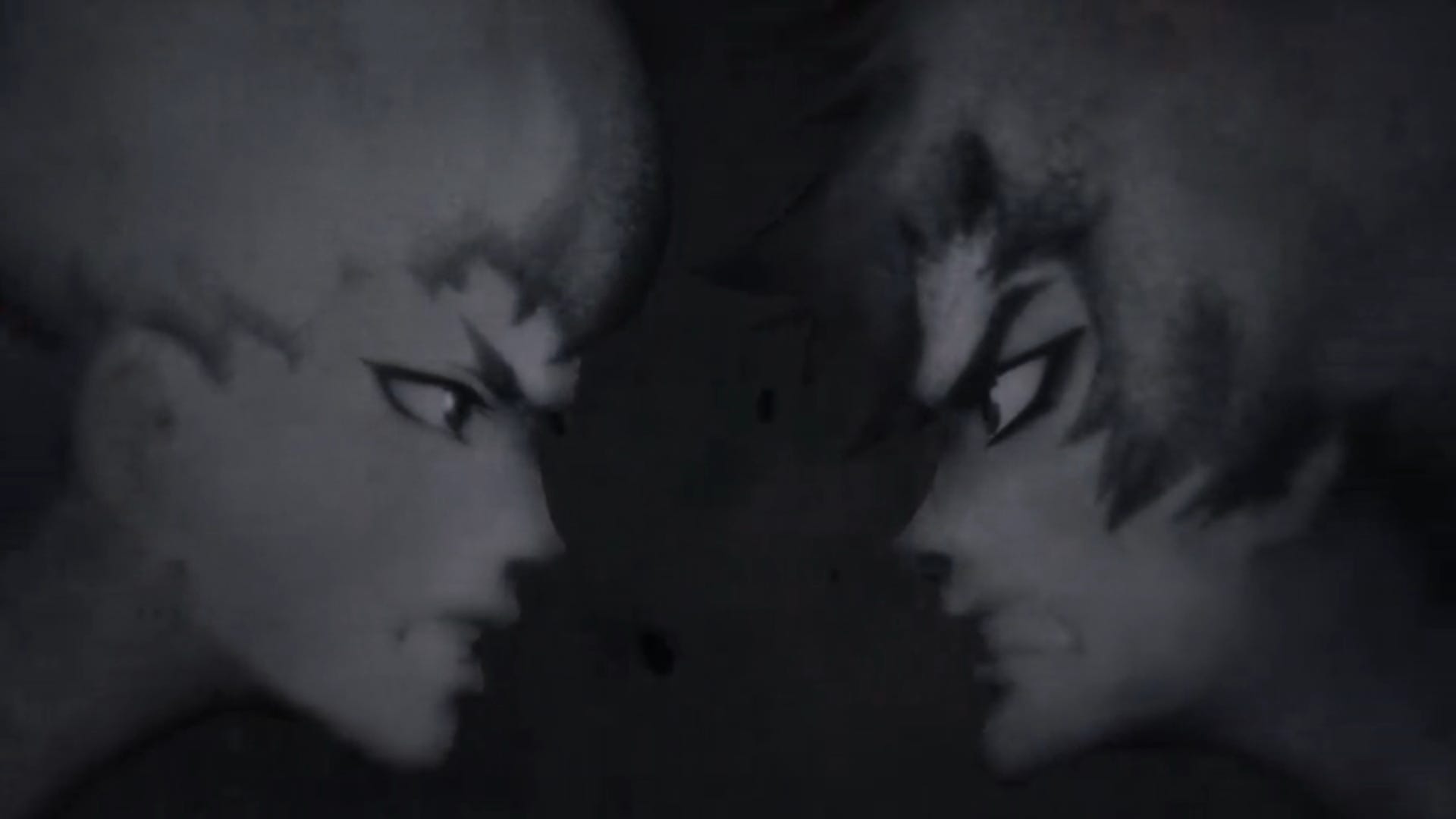
We open on a pastoral scene, overlooking a small village of two-dimensional buildings. Time passes, however, and the land turns arid, barren, black and white.
In this barren wilderness, a dark-haired man grasping his heart in evident pain approaches a light-haired man. “Why did you betray the humans?” he asks.
“Because you humans are weak,” answers Light Hair.
“But you’re human,” objects Dark Hair.
“I’m not human,” Light Hair reveals, and transforms into an angelic being.
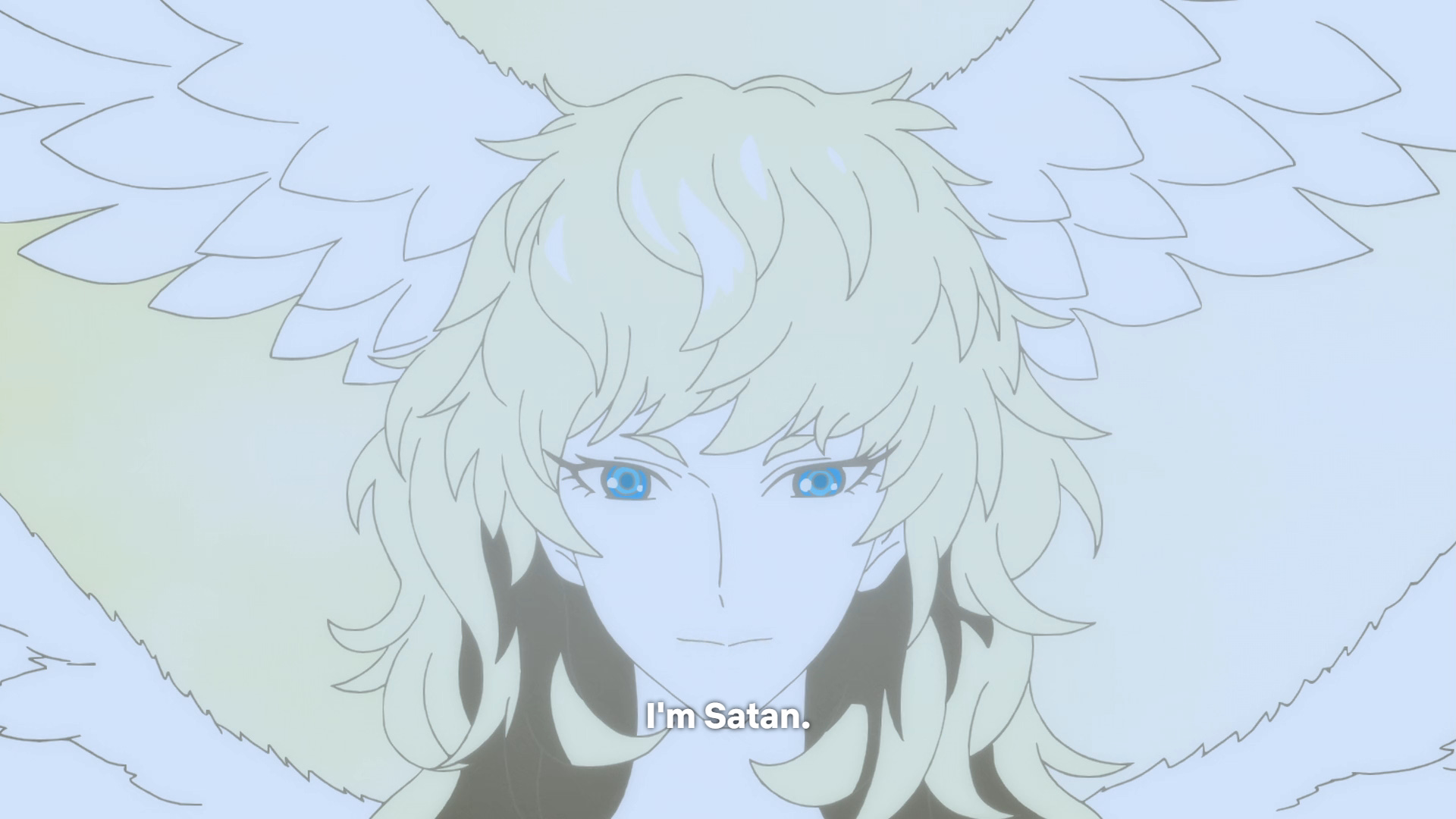
Actually, it’s both, as Satan explains to Akira his history. He is the classic Satan out of Christian theology: the fallen angel, cast out of Heaven for challenging God. Except in this continuity, rather than falling to and ruling over Hell, he fell to Earth. There he found a world dominated by demons - which the flashback montage at first depicts as dinosaurs, but gradually begins to show stranger and more monstrous creatures with magical abilities.
Satan explains that these demons worked by pure Hobbsian evolution: kill or be killed, only the strong survive. Yet the demons could also eat or merge with one another to combine their abilities and become even stronger. Satan would settle down on this world because he liked this philosophy, but a vengeful God sent the asteroids to wipe out the demons and make room for humanity.
Some demons would merge with humans to survive; all mythical beings are examples of these. Werewolves, zombies, vampires, etc. are all examples of demon-human hybrids, and only some people were aware of this.
Satan resumes telling his story, how he was reborn in a human body in some isolated tribe, without his memory of being Satan. His birth is heralded by omens: hundreds of birds falling from the sky, dead; a boar romping gaily through the woods suddenly falling apart in pieces. And then modern soldiers approach the town, I assume on the orders of some government secret organization that knew Satan was there and wanted to destroy him. Satan, by now a child, watches as the town is slaughtered; bombs are dropped from planes; he just stares and watches from a hiding place as everybody he’s ever known dies.
As the scene goes on, I’m not certain about two things: 1) I don’t know if the soldiers are there to kill Satan, rather than standard humans killing humans; 2) I don’t know if Satan survives because he is hidden (unlikely due to the severity of the bombing) or because he is Satan and therefore he just can’t be killed like that1.
Some time later, a young Akira meets the young Satan, just lying there doing nothing (? but that may just be a stylistic decision) and befriends him, bringing him home to I assume Japan. There’s a “Jenny” involved in this somewhere - not entirely sure where.
Eventually, however, Satan (with his memories restored by the trauma) began to revive the rest of the demons - so God had to come and destroy them again.
“You are demon, not a human,” Satan tells Akira.
“You turned my body into a demon,” he retorts. “But I’m not.”
Satan, whose angelic form now looks like a naked woman (though he still has a man’s voice), tries to tempt Akira to his side. “I want to live with you forever in this world. That’s why I had you merge with the Champion.”
Assuming the “Champion” is the strongest of the demons, this is a classic villain error. In the attempt to lure the hero to becoming evil, the villain grants the hero more power than any of the villain’s minions. This enables the hero to handily defeat all of the weaker minions and puts them on par with the villain himself.
Akira and Satan trade verbal jabs for a bit, but finally Akira is fed up. He transforms into his demon form: “I’m going to destroy you all!” But by this time, Satan is summoned far too many demons to back him up. Akira turns and slinks away.
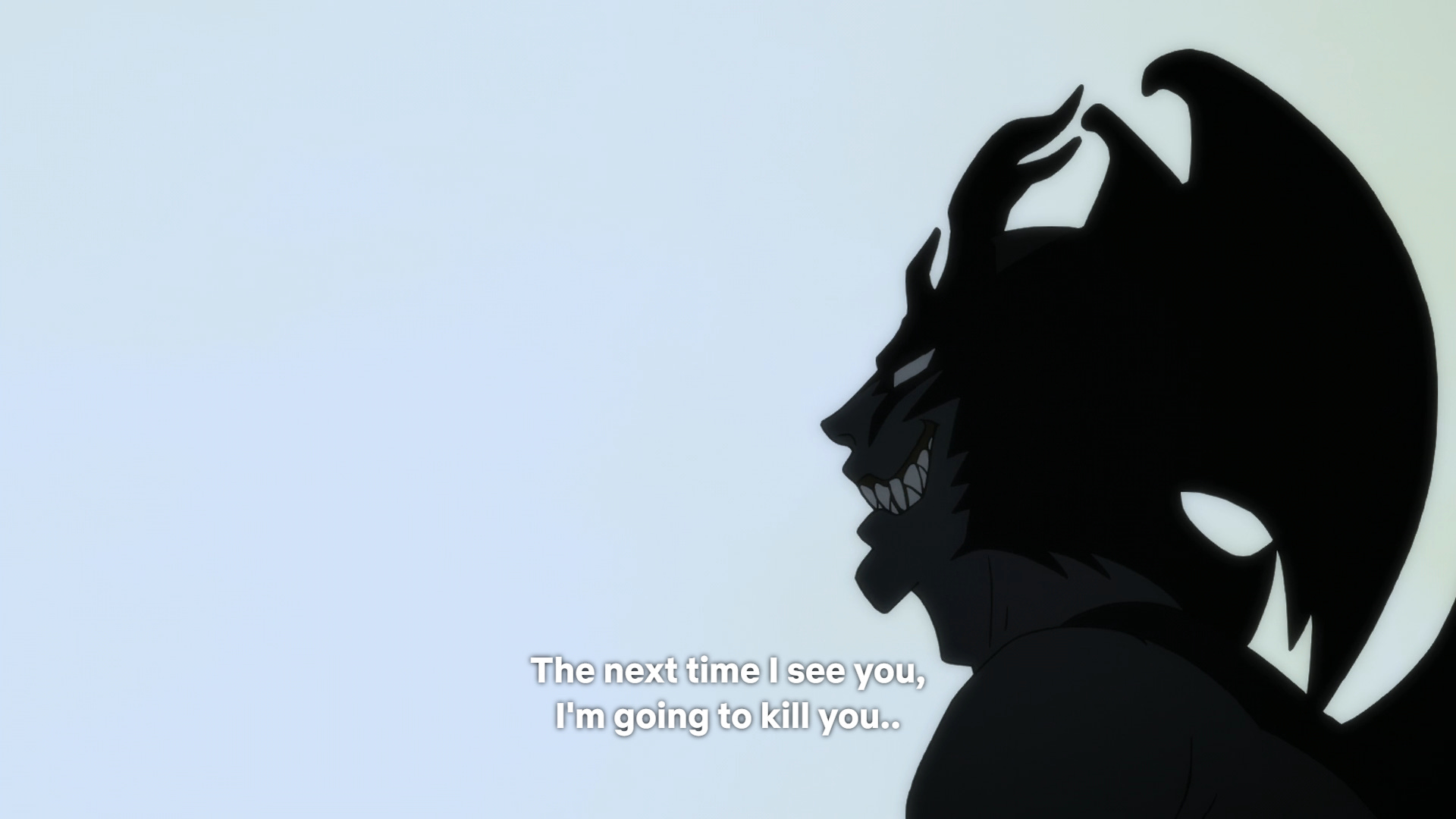
Shortly after Akira leaves, a demon reports to Satan that “Xenon’s men” destroyed his apartment, whatever that means.
A graveyard. Akira lays the head of a young girl to rest, and flashes back to when he promised her that an earring he gave her would protect her. He takes the earring and wears it himself. Curious: is he doing it solely to remember her, or is it actually magical but just wasn’t magical enough in her case?
As he stands there, the titular Devilmen approach from all directions, surrounding the graveyard.
Somewhere else, a human army approaches “their capital”. The commander, speaking in English, encourages the men with, “These are not humans who are occupying our capital! This is not an insurgency!” then moments later contradicts himself by saying, “Annihilate this insurgency!”
The battle begins, and Satan and his minions watch in glee. “The humans are destroying themselves,” he says. So he’s somehow fooled them into thinking the demons are in places where they aren’t?
The war escalates to the use of nuclear weapons, which awakens “the hydra”. But there is a good sign: the humans have located Satan. Planes, ships, even submarines launch missiles at him, but Satan’s minions are too powerful. They use their power to block or blow up the missiles, twist and melt the battleships, killing everybody on board. Views from space show the entire Earth covered in the bursts of explosions, so much so that it’s a wonder any humans are left to fire them.
And indeed we suddenly (a little too suddenly) discover that this is indeed the case. Satan approaches the isolated pocket with the last humans left on Earth.
That’s when Akira arrives2, and calls out “Ryo” as he attacks. I quickly discover that Ryo is the name of Satan’s human identity. Satan, who is obsessed with Akira, orders his other demons not to get involved, and focus instead on the main battle to exterminate mankind.
Somewhere inside this last human facility, there are women in enormous test tubes being experimented upon. One of them shooting breast milk everywhere every time she is electrocuted, a power she uses to fight the invading demons.
I can’t believe I actually typed that sentence out. I don’t even want to know.
Meanwhile, in the battle outside, there are a lot of completely incomprehensible scenes of insane beings being twisted and reshaped in insane ways. I fail to follow any of it.
Soon, however, a demon splits himself in two and merges with Akira, giving Akira a more powerful arm with which to punch Satan. Then Satan tears of Akira’s legs in an attack, but more demons merge with him to give him stronger legs, shouting, “Use me!”
I suspect that these are the women who were being experimented upon, having defeated the demons in the facility and emerged to help Akira. But I can’t be sure at all.
Akira and Satan fight, until suddenly, silence.
A young Akira is sitting at a table with (I think) his family, and he watches happily as they eat a meal together - completely muted - but all of a sudden they turn into chess pawns and their heads fall off.
Intercut with these scenes is the memory of a relay race in which Akira receives the baton from a girl over and over again, and tries to hand it to Ryo, who each time doesn’t bother to take it and lets it clatter to the ground.
Return to the present. The world is a wasteland of lava, and Akira and Ryo are lying on the ground, side by side, staring up at the sky. Now that all the humans are dead, says Ryo, the world is so beautiful! Even the rabbit in the moon (we saw the moon get torn apart earlier in the battle) is dead!
There are a series of flashbacks to Akira and Ryo as children. Ryo is constantly bitter and cynical and quick to commit violence; Akira is endlessly and naively optimistic, trying to keep him good. He stops Ryo from killing random capybaras. They watch a solar eclipse together. Akira sobs at the death of a pet and Ryo can’t understand why, saying, “The weak ones die”; Akira insists that Ryo is crying too, despite this clearly not being the case.
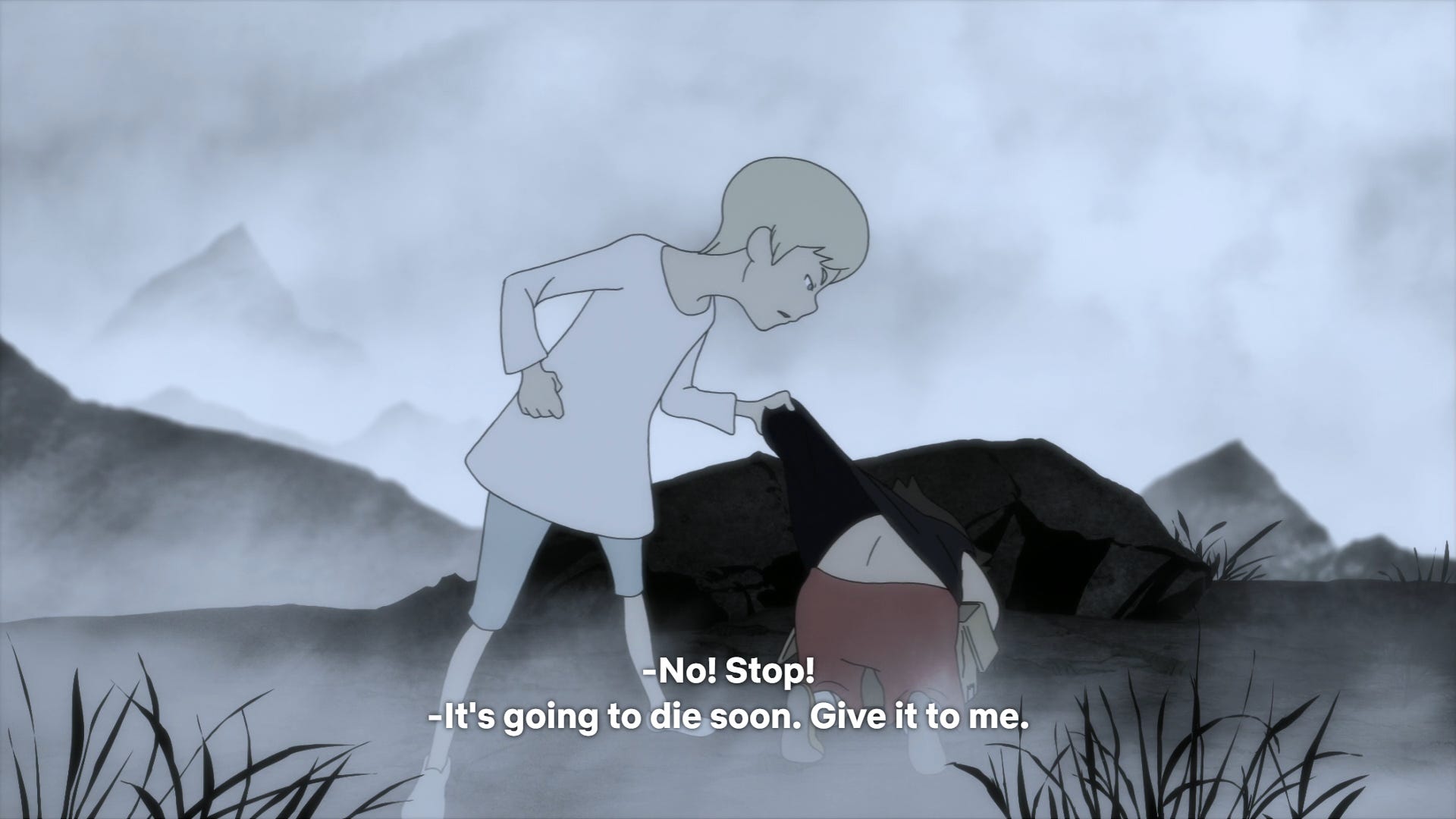
In the present, Ryo continues: “You see, Ryo, there’s no such thing as love. So there’s no such thing as sorrow. Why am I the only one talking?”
The camera pans down to reveal that Akira is only a torso; he died in the battle. Ryo can’t understand: “What am I feeling?” He begs Akira to respond, and breaks down sobbing.
This is why he has been so obsessed with Akira. He wanted to kill all the humans, and he has all his demon minions, but none of it means anything if Akira, the boy who helped raise him, who was with him from the beginning, isn’t there to share it with him.
As he sits there sobbing, another meteor shower (presumably from God) descends and wipes out the Earth.
What a downer ending!
After the credits, the cindering remains of the Earth move aside, and we see another blue-green planet, this one with two moons - presumably God’s next project.
Lingering questions
Is God actually God, or just a powerful alien?
What is his plan from now on? Will he resurrect humanity on this new planet or create an entirely new species?
What was Satan’s plan? Surely he knew that God would destroy the Earth as soon as he won, just like last time. Is he so evil that he’s happy to destroy himself as long as the humans get destroyed too?
Did any demons survive the battle before God stepped in and destroyed them?
Will Satan be reborn? Is this an endless cycle of destruction? What if anything can God do to prevent it?
Is the new planet supposed to be a terraformed Mars? I don’t think it having two moons is a coincidence, but they seemed kind of big. Does this take place far enough in the future that humans have already colonized it, or has God modified Mars to serve this new purpose? Why not remake the Earth itself?
Ratings
I evaluate the finale-of-the-week from an angle that its writers never intended: how well it works as an individual episode watched in isolation. This will likely differ greatly from how the episode works in its proper context. And it should go without saying that the following does not apply to the series as a whole, which I have not watched.
The rating system is from 0 to 10, where 5 is considered average for television. These are intended to be measurements, not judgements; a low rating may reflect low quality, but it may also reflect a deliberate choice. For example, a strong character piece may have no plot, or a finale may intentionally provide no closure - neither of which makes an episode bad.
Story: 3/10. The plot was very simple and too dependent on flashbacks; there was a lot more explaining than there should have been or needed to be. And other than the extinction of mankind3, I saw the ending coming: of course Ryo was actually dead, and Satan was going to discover he had emotions after all.
Writing: 4/10. I joked, during the recap, about how the commander of the human forces announced that “this is not an insurgency” and followed it up mere seconds later with a command to “annihilate the insurgency”.
Less than a minute later, Satan expresses glee that “the humans are destroying themselves”, and follows that up with a description of what will happen after “we destroy the humans”. That’s not strictly a contradiction, but it’s still an awkward juxtaposition that a good writer should catch and fix4.
There were several such examples of awkward or questionable dialogue that could have been polished better. And the episode as a whole had an overreliance on infodumps and exposition (which were very useful to me, but violate the rules of good storytelling).
The flashbacks were superfluous and should have been significantly cut down, with two significant exceptions, which I’ll analyze under “Characterization” below.
Production: 4/10. The animation of the opening credits created expectations that the episode couldn’t fulfill; most of the actual episode was of a quality typical of the 90s rather than the far superior animation of today. If this series had come out in the 90s, there would be nothing wrong with obvious “busy” animations and pans across unmoving characters - but this came out in 2018.
The low-quality animation is somewhat made up for by the great music and good acting from the two leads. Ryo in particular sold the heartbreak over his dead friend exceptionally well.
Characterization: 8/10. There were only four people we spent any time with at all in this episode: Ryo, Akira, Young Ryo, and Young Akira.
I loved the characterization of the young Ryo and Akira. Ryo constantly pulling out his box-cutter, and Akira gently shaking his head and pushing Ryo’s hand down… those moments spoke volumes about who these two characters are, without the need for a single word. I instantly grasped who Akira was and how he sees the world, and how he approached growing up next to Literal Satan. The repeated scene with the baton took me embarrassingly long to understand, but it showed that Young Akira is the kind of person who will keep trying, keep putting out his hand no matter how often it is slapped away, endlessly optimistic and ready to accept his friend if only his friend will reach out to him.
But old Akira is nothing like that. All he has is a raw fury and desire to kill Ryo. Which is not a contradiction. Murdering the entire human race is one of those misdemeanors that might - and probably did - turn even a Young Akira into an Old Akira5.
As for old Ryo, the baton and boxcutter scenes also skillfully illustrate his character. In the famous quote that actually predates Stalin, “The death of one man: that is a catastrophe. One hundred thousand deaths: that is a statistic!” When we’re simply told6 that all of humanity is dead, that doesn’t move the viewer very much. But when we can see just how badly Ryo has destroyed Akira’s boundless optimism, just how much this innocent and good boy has been reduced to a murderous shell of his former self, it gives us something to latch onto. That’s why the baton flashbacks are deliberately juxtaposed with the depiction of Akira at his least human, at the height of the pitched battle between the two7.
Accessibility: 6/10. The infodumps and expositions made the basic plot easy to understand, though the lengthy fight scenes were more difficult to follow.
There’s clearly a lot of backstory that I’m missing: What were those people doing in the facility? Who were the demons that helped Akira out during the battle? How and why did the humans destroy themselves so thoroughly in their desperation to kill the demons? Why does Satan describe God as “cold”, and was he right? Why didn’t God step in to stop the demons sooner - is it well established that he doesn’t care about humans after all? Why does he care about getting rid of the demons?
But as a whole the episode was more accessible than average.
Closure: 9/10. The destruction of the entire human race isn’t closure enough?
Well, not quite. I listed some lingering questions above. But those are minor. The tragedy of Satan - which is the actual story this episode was telling - has concluded. He died, alone, lamenting that he has killed his best friend. A fitting end for a being of pure evil.
Do I want to watch the series now?
I’m seriously considering it. I am very curious as to what has happened to Akira beyond the obvious. I assume the show starts with them as children (with the flashbacks in this episode coming from the series opener) and follows them as they grow up, and Akira is slowly and repeatedly broken by Ryo’s inability to change… or something along those lines. It promises a great story, but I worry about the quality of its telling.
Is there a series finale you’d like me to try? Join our Discord or leave a comment below.
Which in retrospect makes me wonder how he died the first time. A strong enough asteroid impact is more powerful than nuclear bombs, sure, but later we’ll see many such bombs launched without even wounding Satan.
I didn’t notice at the time, but it’s not really explained how he escaped from and/or defeated the hundreds of demons in the graveyard. We can perhaps infer that his merger with The Champion makes him stronger than anyone except Satan, but it would still have been nice to see some of how that went down.
“, how was the play?”
It’s possible that this is a failure in the translation only, and that the Japanese dialogue was fine. Translation quality falls under the Production rating, but only in cases where I am certain the translator did something particularly stupid or brilliant. Otherwise I assume they are faithfully communicating what was written in the original.
While Akira protests that it his only his body that has become that of a demon, and not his mind, I can’t help but wonder if that transformation contributed to this.
(not even shown, which is one of the problems that I have with the writing outside of the Ryo-Akira relationship)
If only the rest of the episode had been written this well!