
Requested By
.· Ben ⬩ Salvidrim! ·. on our Discord server. Thank you for supporting the Substack!
What do I know about this series going into it?
Never heard of it.
Recap
A cube-shaped room, yellow, with flashing lights and surfaces covered in ball bearings. There’s a voiceover from an unseen “Stewart”1 about a falconer and a falcon and other nonsense; after a few moments it becomes clear he’s quoting something, but it’s not until he mentions Bethlehem that I conclude it’s probably from the New Testament.
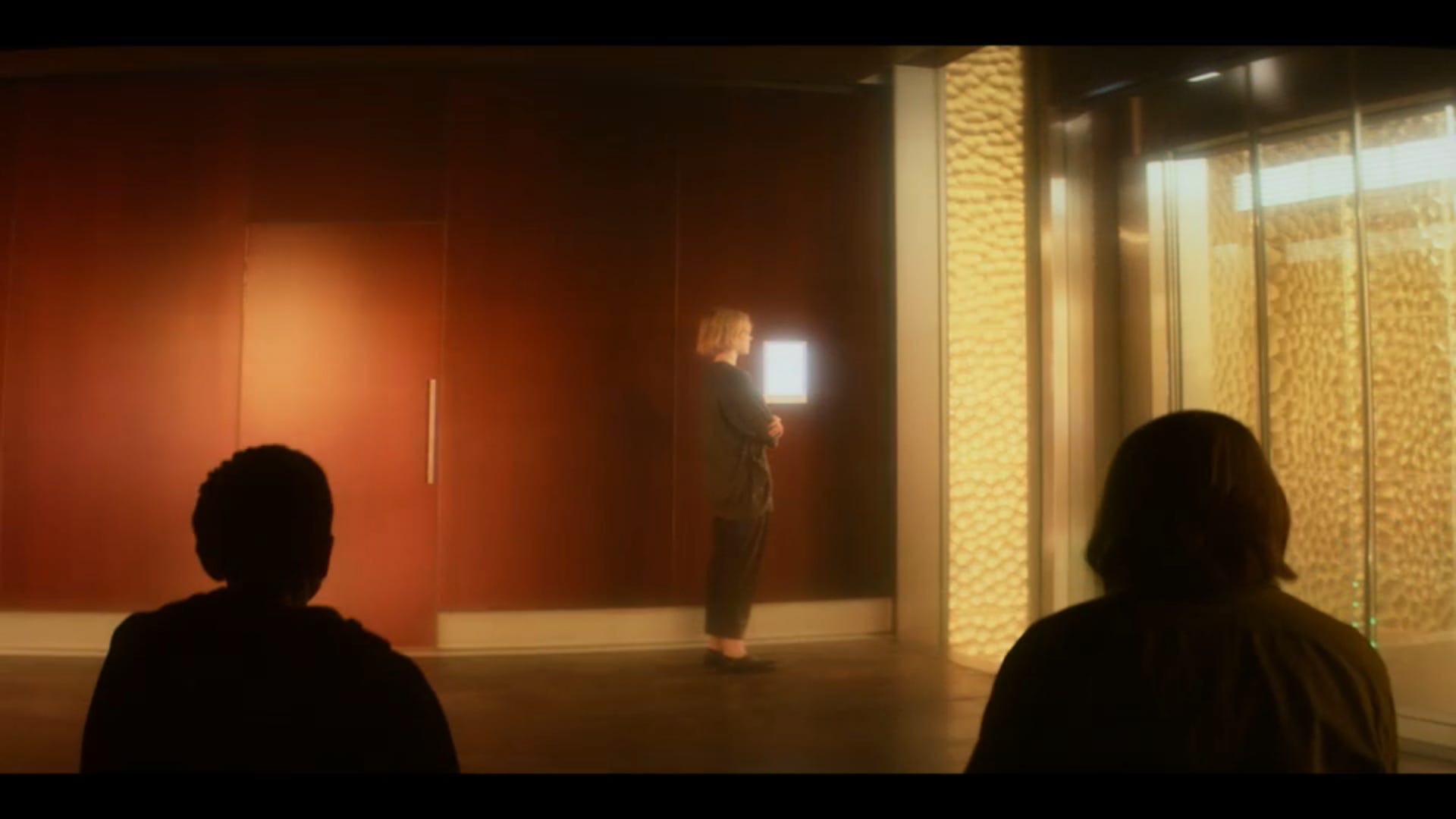
A glass elevator with a figure inside it slowly descends into the room. The doors open, and she slowly walks out into a series of hallways with glass walls. It’s clearly an empty office (that of a tech company, based on the show’s title), but aside from the familiar workstations and laptops the decor is really strange. As she explores, she looks around with an expression of either wonder or familiarity - it’s hard to tell. I’m also not 100% sure this is a she.
With some trepidation she approaches a door that is slightly ajar2. Inside, waiting for her, is a bearded man who calls her “Lily”. She closes the door behind her, which doesn’t seem smart given the air of menace in the scene.
Lily asks where “Katie” is. “Here in the labs,” says the man, whose hair, clothing, and tone of voice give off a massive Jesus-like vibe. “But we’ll find her in half an hour.”
“I don’t know what I am,” says Lily. “I make no decisions have no choices.” Has she just discovered that she is a robot?
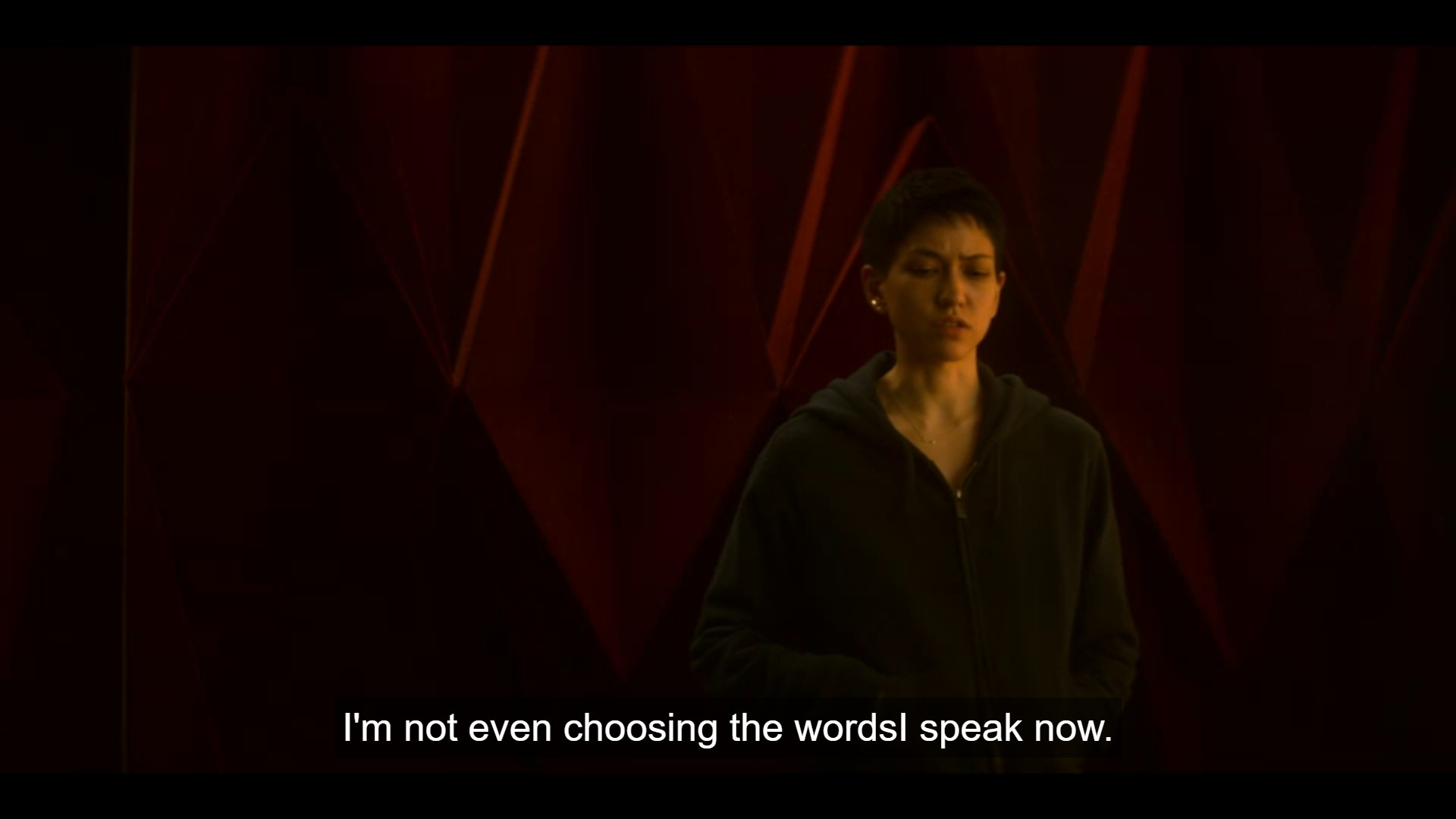
“I’ve watched this scene many times,” answers the man, “and both you and I always say the same thing.” So are they both robots? Or is this a free-will-is-an-illusion sort of thing?
She blames him for taking everything from her, but he insists (still talking slowly and gently, in a bless-you-my-child tone) that he took nothing. “Life is just something we watch unfold.” So this is a free-will-is-an-illusion thing. I’m guessing their memories of this encounter have been repeatedly erased and they always do the same thing every time. But that raises the question of what happened in the first iteration, when there were no previous iterations of the scene for the man to have watched.
There is a projection on the screen of a little girl in a field. Lily recognizes it as the man’s daughter. But Jesus (I’ll call him this until I learn his real name) corrects her: it’s a simulation of a moment in his daughter’s life. Every particle in the universe affects every other particle, so if you have enough data about the state of even one particle you can extrapolate the state of literally everything else in the universe3.
This is Newtonian physics, of course, and violates the Heisenberg Uncertainty Principle, but maybe they papered that over with a Heisenberg Compensator in some previous episode.
According to Jesus, his daughter Amaya is alive inside the simulation. Lily insists this can’t be true, because the simulation is going through fixed motions. But Jesus gives the obvious rebuttal: so does every human being.
“Jamie told me this morning,” says Lily, “that tech company leaders start to think they’re messiahs.” So his Jesus-like demeanor isn’t my imagination; it’s deliberate, and maybe even too on-the-nose.
“This is the moment you take the gun out,” says Jesus. “You take it out of your pocket, where you were hiding it, the gun that Kenton used to kill Jamie.”
Lily does so - which is a strange decision. If you’re told that you don’t have free will, and your next action were predicted out loud, wouldn’t you do something davka4 to prove you could disobey?
But despite her compliance, Lily isn’t so quick to abandon all hope of independent thought: “You knew I was going to come here and you know everything that is going to happen,” she says. “But I do something and your system breaks.”
Jesus admits she is right.
“Show me,” says Lily. “I want to see what you’ve seen happen.”
Jesus sits Lily down and they watch the simulation, in which she forces him into the next room at gunpoint. Katie - played by Alison Pill! - is waiting there, and she isn’t happy with whatever is going to happen next. Jesus assures her that it will be okay, but she reacts angrily: “I don’t know why you say that!”
I’m a little annoyed at myself that it took this long to realize, but what I said earlier about memory erasure is clearly incorrect. Jesus has watched this happen hundreds of times in the simulation. And the simulation’s depiction of events takes into account how the people involved will behave as a result of having watched it.
The only problem with this sort of scenario is that it necessitates the people involved having no davka tendencies whatsoever, never disobeying even if only for the sake of proving that they can.5
The simulation continues with Jesus and Lily getting in another elevator. He is not concerned about the gun: “Messiahs get resurrected.6” The simulated Lily shoots him dead, which shocks the real Lily watching the video. But the bullet also breaks the glass wall of the elevator behind Jesus, destroying the “vacuum seal” that is somehow suspending the elevator in midair. The elevator falls and its walls shatter. Lily crawls away from the elevator, weak either from broken legs or lack of oxygen or both, and dies.
“I kill us both and nothing can change it,” the real Lily realizes. Jesus confirms this, but also admits that “We can’t see beyond that moment in time.” I’m guessing this means the machine is connected to him somehow and it can only work as long as he is alive.
Lily is open about why she wants to kill Jesus: it’s “for Jamie”. But does she really want it to happen in this particular way? As far as I can tell, the only reason Lily hasn’t killed him yet is because she’s looking for Katie. But she now knows, thanks to watching the video, where Katie is. So why wait until they enter the elevator, if she knows it will mean her own death as well? Is there something else she wants to force Jesus to do at gunpoint - take her somewhere or do something that she can’t do on her own? Even if that’s the case, if the magic prediction machine has told her she won’t have enough self-control to keep him alive, all the more reason to jump the gun7 and do it now. Then, whatever that other goal is, she’ll have time to work out another way to reach it.
Jesus reveals: The project is not actually called “Devs”. It’s “Deus”; the ‘v’ is the Roman straight-angled ‘u’.
It’s time. The door to the back room opens, just as it did in the simulation, and Jesus enters, Lily holding him at gunpoint. She has the same hard, self-assured expression on her face that her simulated counterpart did - which is odd given she was drowning in self-doubt mere moments ago. They go through the same scene with Katie, during which captions reveal that Jesus’s real name is Forest (I think they’ve said it before, but I didn’t really absorb it until now).
Lily and Forest get in the elevator. But this time, mere moments before the doors close, Lily tosses the gun outside, shocking Forest and Katie both. Forest is horrified, as his entire worldview comes crashing around him: That’s not possible! But Lily points out that, far from getting resurrected, Messiahs are actually false prophets8.
But unseen by all, a man who looks like Brian Blessed is in the other room. He enters a code into a panel that disables the floating cube. And it falls, just like before.
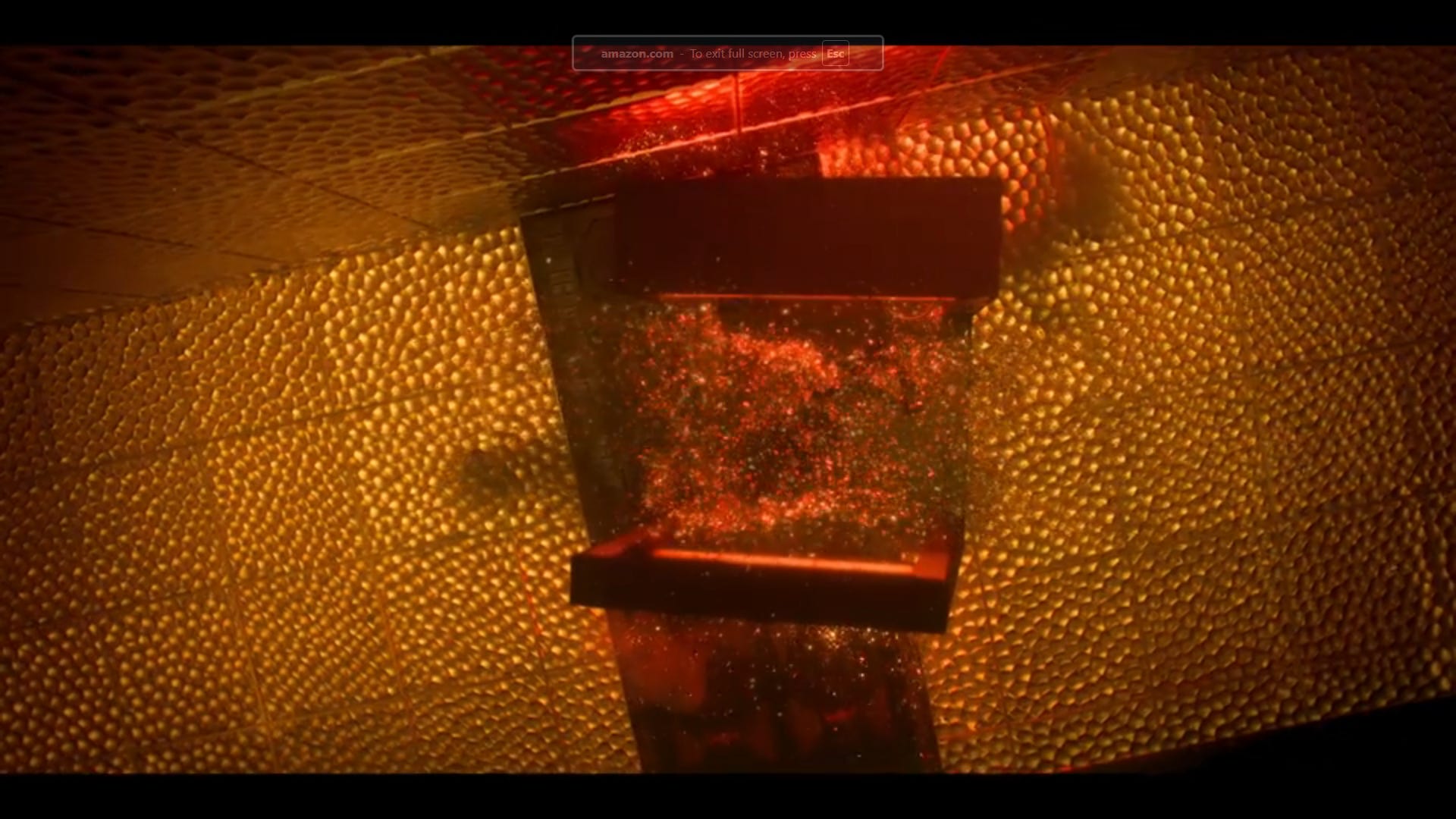
This time they’re both alive to crawl out, but they still suffocate and die.
Katie, watching from above, sobs. “Why?” she asks Brian Blessed. “Because someone has to stop this,” he says, unaware that moments ago Lily already did. “Don’t blame me, it was predetermined.” And he turns and walks away.
A field of white. Echoing shouts, as Forest coalesces out of nothing inside a simulated featureless expanse. He hears Katie talking to him from reality: he was indeed resurrected as he claimed he would be, in this simulation of him that remembers everything up to the moment of his death. He and Katie acknowledge that Lily actually made a choice for the first time in her life. She committed the original sin, disobeying what Deus - the computer - said she would do.
Katie says something about Lyndon’s principle, whatever that is, and disperses the simulations of Forest and his daughter Amaya.
Lily wakes up. She’s standing near a window in her home, unsure of how she got there, but the expression on her face shows clearly that she remembers dying. Her boyfriend is in bed, asking her she had a bad dream; this is clearly a recreated moment from her past.
They leave the house, stepping over a homeless guy - Forest - on their doorstep. She glances back at him as if she recognizes him.
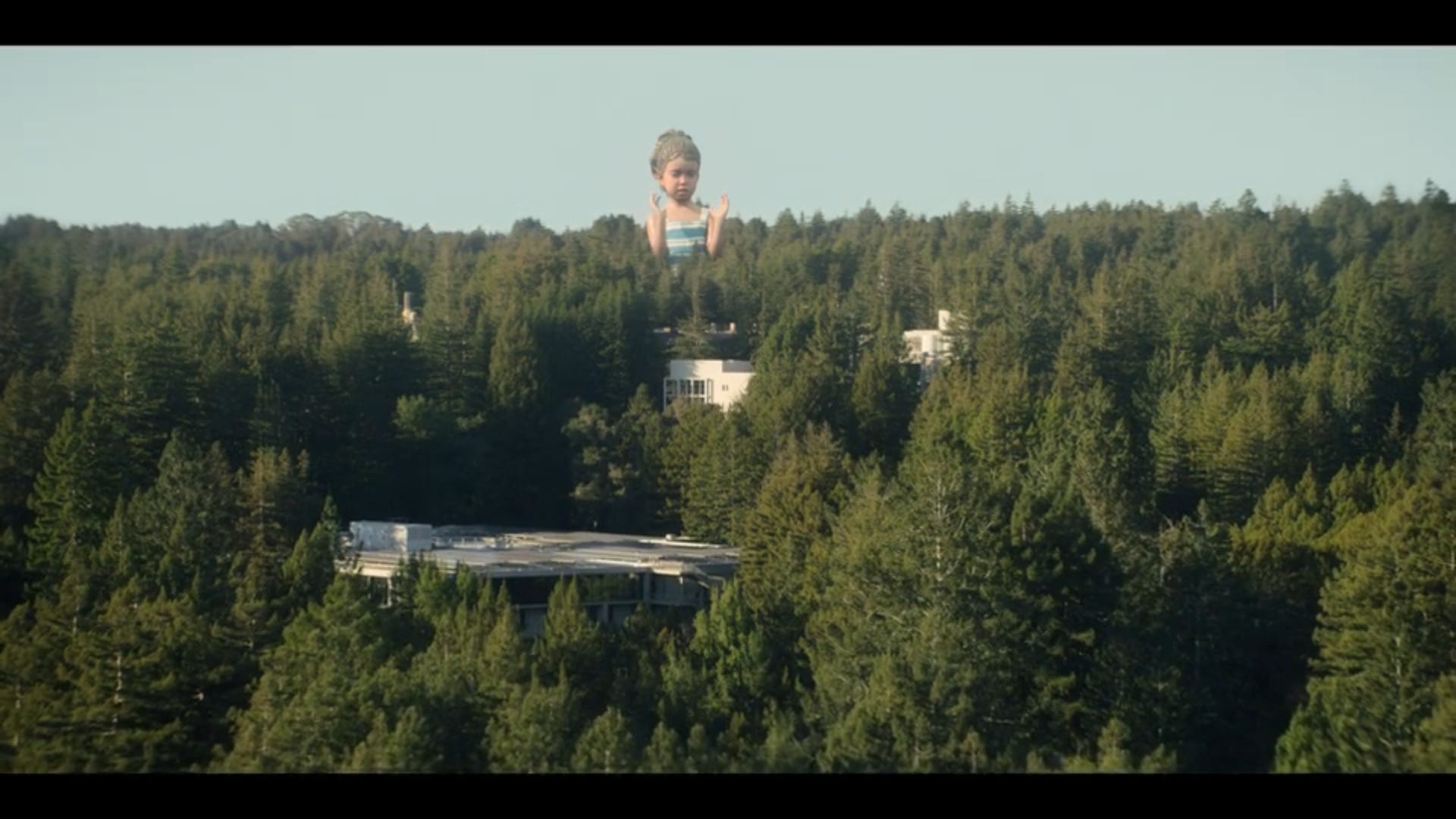
Lily and her boyfriend take a bus into town. The name of the bus company, reprinted on all of the seats, is Amaya. And an establishing shot shows a giant, creepy, Squid Game-style statue of Amaya off in the distance. When they arrive at their destination, the tech company is also named Amaya. So this isn’t quite a faithful recreation of the past, but an Amaya-centered artificial universe.
Forest drives past Lily and her boyfriend. Lily stares after him, hypnotized, which prompts her boyfriend to ask what’s the big deal: we see Forest around all the time!
Lily asks to see her boyfriend’s phone. He thinks she thinks he’s cheating on her, but she opens the Sudoku app. He takes his phone back, annoyed at her for choosing today of all days, when he has an important something (job interview?), to act all weird and sabotage him. I’m guessing that since they’re in her past, it’s really important that the Sudoku app be open, to avert some disaster.
Her boyfriend enters the building, but Lily herself walks into a city park, and from there into a forest, where trees have glowing rings around them.
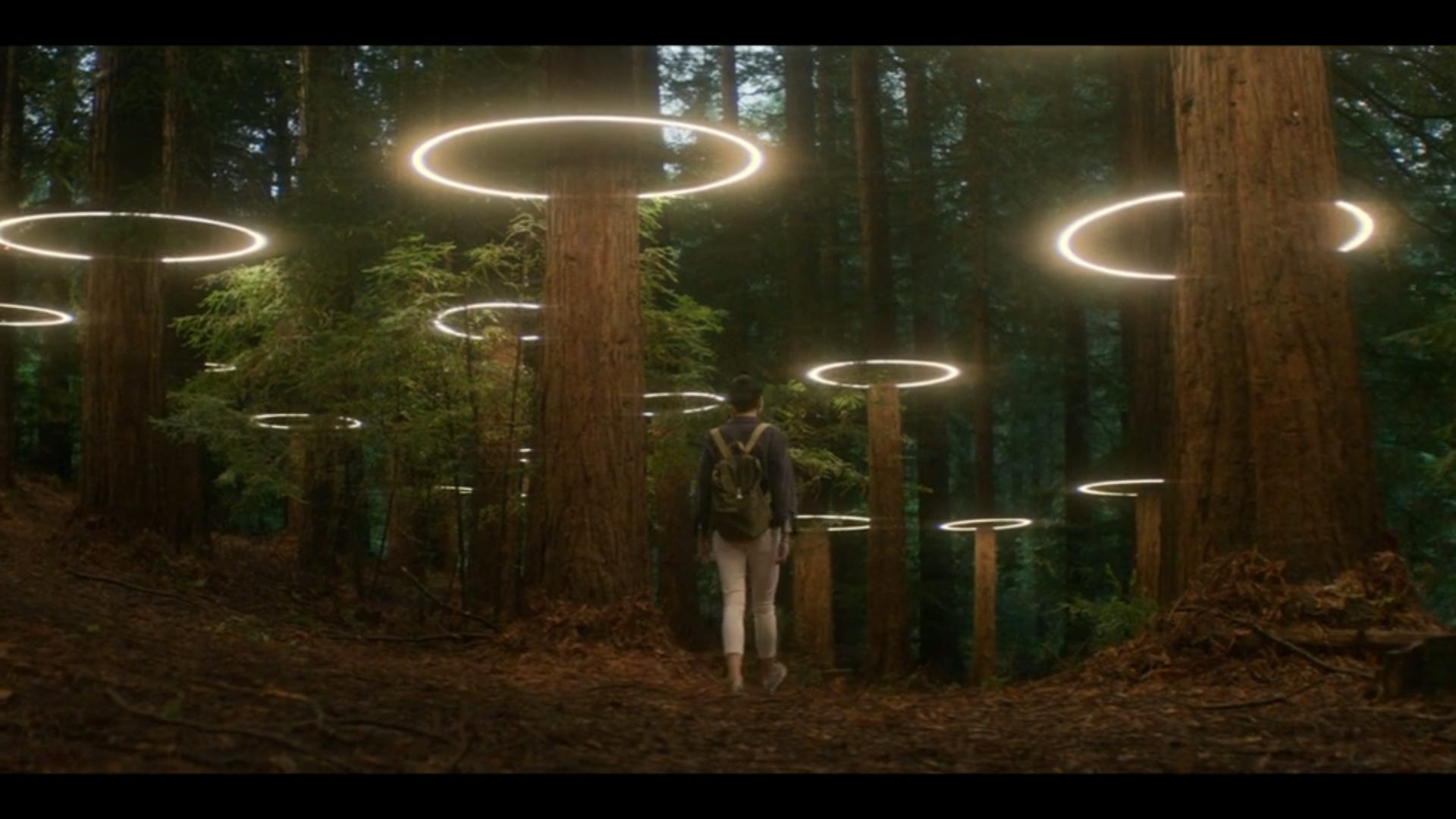
When she emerges from the forest, she is well outside the city, in a field in the middle of nowhere. Forest is there, playing with his wife and daughter. He knows her, and he knows she knows him. “I don’t understand what’s happening,” Lily says, echoing my own thoughts. “We died.”
Forest confirms this, but clarifies that they’ve been resurrected in the simulation, as promised. The computer is God and this is the afterlife, a paradise that Forest constructed: He has his wife and daughter, and Sergei (I assume Lily’s boyfriend) hasn’t been killed yet. And nobody - not even Forest’s wife and daughter - knows this is a simulation except for the two of them.
Forest explains that he had asked Katie to upload the data about their lives into the machine at the moment of their death. And there are multiple simulations, including heaven and hell. As he describes this, the camera cuts multiple times to the same field with different lighting, with no interruption in his speech. It’s all very weird.
Meanwhile, in reality, Katie describes the situation to a woman the captions call Laine. Laine wants to confirm that existing in the simulation feels identical to reality (though I don’t see how anybody can know for sure). And Katie asks Laine for help keeping the simulation running in perpetuity.
Inside the simulation, Lily runs into Jamie and embraces him.
Lingering questions
Who is Laine? What is she planning? She must be planning something. Anybody who asks the question “Who else knows about this?” is necessarily up to no good.
How long will they be able to keep the simulation running? Is time inside equal to time outside?
Will Brian Blessed be brought to justice for committing two murders?
Has Forest programmed Sergei to never break up with Lily, or has she damaged her relationship with him through Sudoku-related antics? Can other things go wrong in the simulation: car accidents, illnesses, economic downturns? Will they grow old and die?
Who won the philosophical debate? Forest seems to acknowledge that Lily has acted non-deterministically. But then again the existence of a simulation indistinguishable from the real world would seem to imply that he is correct, and human thought is computable. So is there free will or not? Did Lily change things, or did viewing the future merely send her decision-making process down a different but equally deterministic path?
There’s no such thing as a program without bugs in it. And it seemingly took three or four tries to load Forest’s consciousness into the computer after his death. So what made everyone so sure that the program’s extrapolations of the future are errorless?
Ratings
I evaluate the finale-of-the-week from an angle that its writers never intended: how well it works as an individual episode watched in isolation. This will likely differ greatly from how the episode works in its proper context. And it should go without saying that the following does not apply to the series as a whole, which I have not watched.
The rating system is from 0 to 10, where 5 is considered average for television. These are intended to be measurements, not judgements; high ratings are not necessarily better and low rating are not necessarily worse. For example, a strong character piece may have no plot, or a finale may intentionally provide no closure - neither of which makes an episode bad.
Story: 3/10. There was only one story thread, with no subplots. It kept me riveted, but there’s a noticeable plot hole. The point in time where Lily does something to break the simulator (changing how she acts as a result of seeing how she will act) happens just as the elevator doors close. The simulator shouldn’t be able to depict anything beyond that point - and yet it continues showing events for up to a full minute after that. How is it able to do so, and what’s so special about Lily’s death that that’s the point after which it no longer works?
Writing: 8/10. I have so many problems with the logic, and yet the writing is superb. The metaphor of tech-entrepreneur-as-Jesus could have been cliche (and yes, they leaned a little bit too heavily on that), but they added an impressive number of layers to it. I think I must’ve said “wow” out loud when Forest described rebelling against deterministic predictions of our behavior as Lily’s “original sin”. And putting computer-simulation-as-afterlife on top of that? They definitely put a lot of effort into a concept that (let’s be honest) probably started with the Deus/Devs pun.
Also, and this is rank speculation, but I’m guessing Forest is a meaningful name. His invention takes a small part of the universe and uses it to extrapolate everything else. He’s literally seeing the forest for the trees.
Production: 9/10. A work of art. Every part of the episode was designed to further divine metaphor: the imagery of the falling elevator, the use of slow motion, the music and sound design. The sets and lighting were beautiful. The slow burn of the episode’s pacing was perfect for the story it was trying to tell.
As I’ve said above, some of the imagery was too on-the-nose, but it may well be that Forest is in-universe trying to effect a Jesus-like demeanor. And certainly the actors did an excellent job communicating it.
My only real problem is with the shift in tone when Lily and Forest enter the back room to find Katie. There’s a major disconnect (though see below) between how Lily was acting mere moments earlier. It hurts the continuity of the scene. But that’s a minor issue.
Characterization: 3/10. There were only two characters with whom we spent time in this episode; I barely learned anything about Katie or Sergei or Brian Blessed.
Of the two major characters, only one of them, Forest, did I get to know well at all. Lily is a bit of a cipher, though one wonders if they were deliberately going for that because of her (and Forest’s) belief that she’s never made a decision in her life. Which is a bit of a shame, because my problem with the shift in her demeanor might well be answered if I knew more about her personality. Is it possible that she was lying all along, and adopted the mask of self-assurance solely to make Forest think, until the last possible moment, that she was going along with his machine’s prediction?
I also don’t know what Lily was after - and whatever it was, she’s now too dead to pursue it.
Accessibility: 6/10. Despite my initial confusion it was pretty easy to pick up the main plot by midway through the episode. And there were very few characters I needed to learn.
I still have a lot of leftover questions about what is going on, especially regarding character motivations. Why is Forest so welcoming of his would-be murderer into his afterlife?
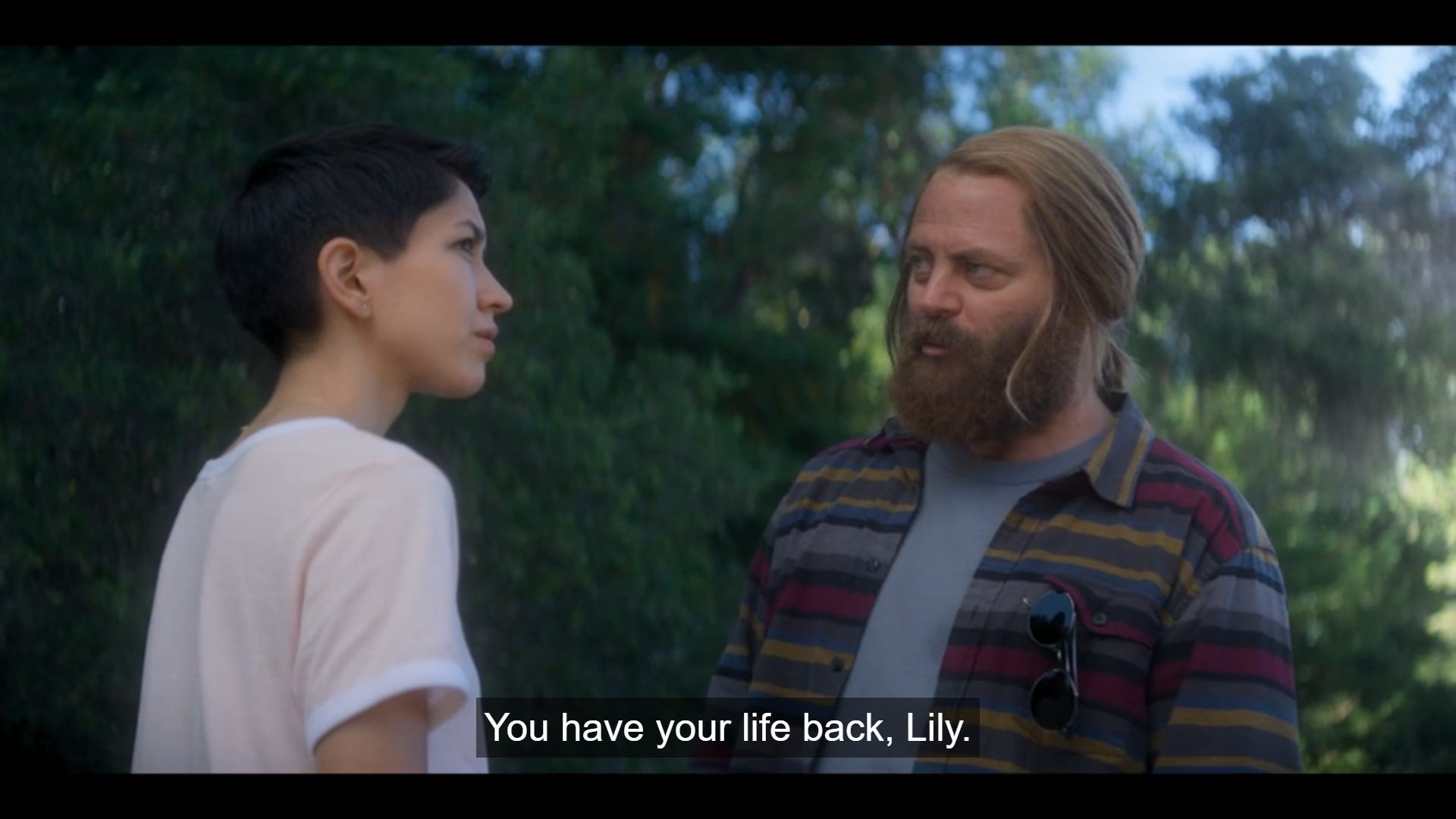
And why has Lily changed her mind about killing him? She can still do it, in the simulation. Or has Forest ordered Katie to conveniently leave out “part that wants to kill me” when she uploaded Lily’s consciousness?
Closure: 3/10. This is very subjective - so subjective that I considered giving it a 6 or even higher before changing my mind. On the one hand, the two main characters are dead; you don’t close a door much more firmly than that. But on the other hand, you are expected to take as part of that closure the knowledge that Forest and Lily have joined their loved ones in the afterlife - which only works as closure if you buy into Forest’s belief that this is the afterlife. And even if you accept that it is, the show went out of its way to cast doubt on their ability to survive in the simulation indefinitely.
Do I want to watch the series now?
It’s very tempting. On the one hand, I want to just jump in and read everything about it without watching it. On the other, the production values were so high that it may well be worth watching the entire series. I’m on the fence about it but leaning towards yes.
Is there a series finale you’d like me to try? Join our Discord or leave a comment below.
Name given in captions.
When is a door not a door? When it’s a jar.
They could be using it to discover if there’s life on other planets, find out what happened to Harold Holt, spy on high-level meetings in the Chinese government. I’m guessing Jesus’s daughter died and his obsession is to resurrect her, but there are so many other good things to do with this technology!
Davka is an extremely useful Hebrew word with no analogue in any other language I’m aware of. It means something along the lines of “despite” or “out of spite” or “contrary to what you’d expect” or “what Alanis Morissette mistakenly thinks ‘ironic’ means”. Some examples:
“It davka rained on my wedding day.”
“You always do the opposite of what I recommend. Why are you so davka?”
“Davka when the stock market is dropping that is the best time to buy.”
“If your machine predicts I’m going to take the gun out of my pocket, I will davka leave it in my pocket to prove that I can.”
For example, writing this footnote after the episode, why doesn’t Katie vary her actions at all? I can understand why Jesus - obsessed with the power and the deep truth about the universe that he has uncovered - refuses to deviate from the path that has been laid out, even though it leads to his death. But Katie clearly cares for him and doesn’t share his messianism. Surely she’d change the words of her sentence slightly, or stand in a different part of the room, in the hopes that even such a slight change might avert his death.
The only thing I can think of is the possibility that Katie fears varying from the machine’s prediction will result in Lily shooting her. That’s not the vibe I get from the characters, but I can’t be sure given the lack of direct interaction between them.
This is not true about the Messiahs of all or even of most religions.
Pun not intended
Well, technically every Messiah is a true prophet of their own religion.
"A work of art." "The writing is superb." high praise for a hidden gem series <3