
Erased (2017)
“E12”, Season 1 Episode 12
Requested By
.· Ben ⬩ Salvidrim! ·. on our Discord server. Thank you for supporting the Substack!
What do I know about this series going into it?
Never heard of it before the request. It’s a live-action anime adaptation, and while clicking through I accidentally glimpsed that it belongs to the time-travel genre.
Recap
Outdoors, night. A man with two packages in his hand delivers one, then starts to walk across a rickety wooden bridge with the other. But before he is halfway across, he is surprised to see another man, on crutches, waiting at the other end. The two identify each other as Satoru and Mr. Yashiro, with Yashiro placing his package on the bridge before him. Satoru has come to “end this”, while Yashiro is “ready to kill” him. “Aha, you’ve regained your memories,” says Yashiro. “And you knew I would use my cellphone, which didn’t exist when you were a child, but I had a backup plan!” The backup plan, we see in a flashback, involves Yashiro walking past an unsuspecting girl and tucking a piece of paper into her backpack.
Okay, I have no idea what’s happening, and so far this is deliciously strange.
Returning to the present: “How did you put me in this trap?” Yashiro asks Satoru.
“You never intended to kill Kumi,” accuses Satoru. “Only me.”
“I was planning to kill her,” corrects Yashiro. “But I also knew you would stop me, and I only wanted to kill you.” Which is just a roundabout way of saying Satoru is right.
Yashiro then notices a glint in Satoru’s eye. He interprets this as Satoru having “already figured out how to get out of this”. Which makes no sense - isn’t Satoru ambushing Yashiro? Didn’t Yashiro point out moments ago that he is “inside the trap” and Satoru is “outside the trap”? What exactly does Satoru need to get out of?
Also, nothing’s stopping either of them from turning around and walking back the way they came. How exactly are either of them trapped?
Satoru limps towards Yashiro - who hallucinates him as a preteen girl. I’m guessing that’s the aforementioned Kumi.
Satoru starts to blather about something vague, so meanwhile let’s try and work something out here. I know the show involves time travel. So Satoru comes from a time before cell phones - maybe even before technology? But that doesn’t work, because they mention Satoru having graduated from grade school and being in a car 17 years ago. I feel like I need to wait a bit longer to develop a theory.
Satoru points out that he has relived the past multiple times: he’s been a fifth-grader three times and has lived through the current year of 2005 twice.
Fireworks go off in the distance. The two pause to look at them.
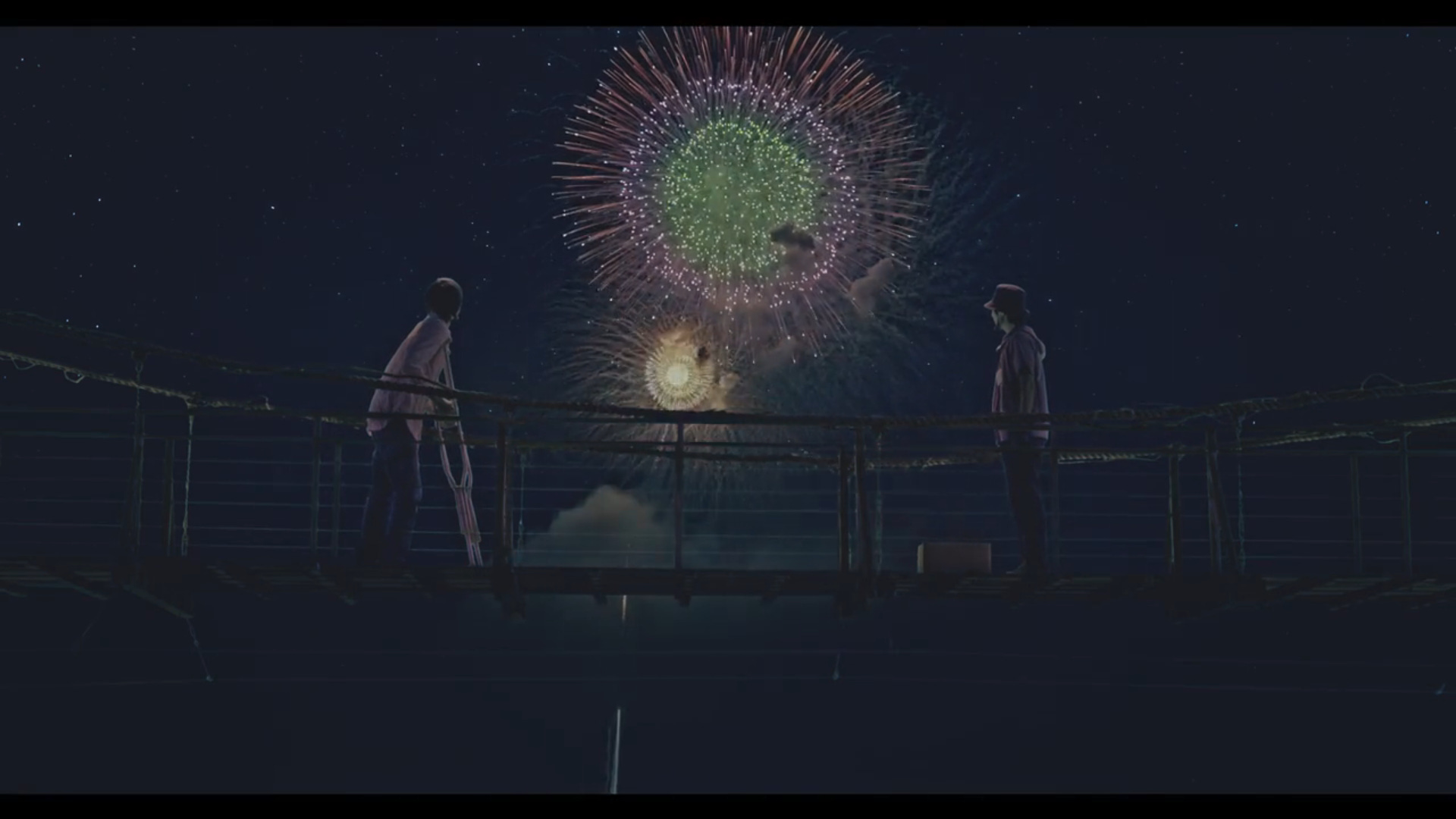
Yashiro says that this information on time travel from Satoru explains a lot. I’m glad it helped him, but I’m still very much in the dark.
His next question is philosophical: Am I evil? Society considers me evil, but who says society is right? Evil is just what people call the inner desires around which they wrap the thing they do in order to claim they’re good (or something).
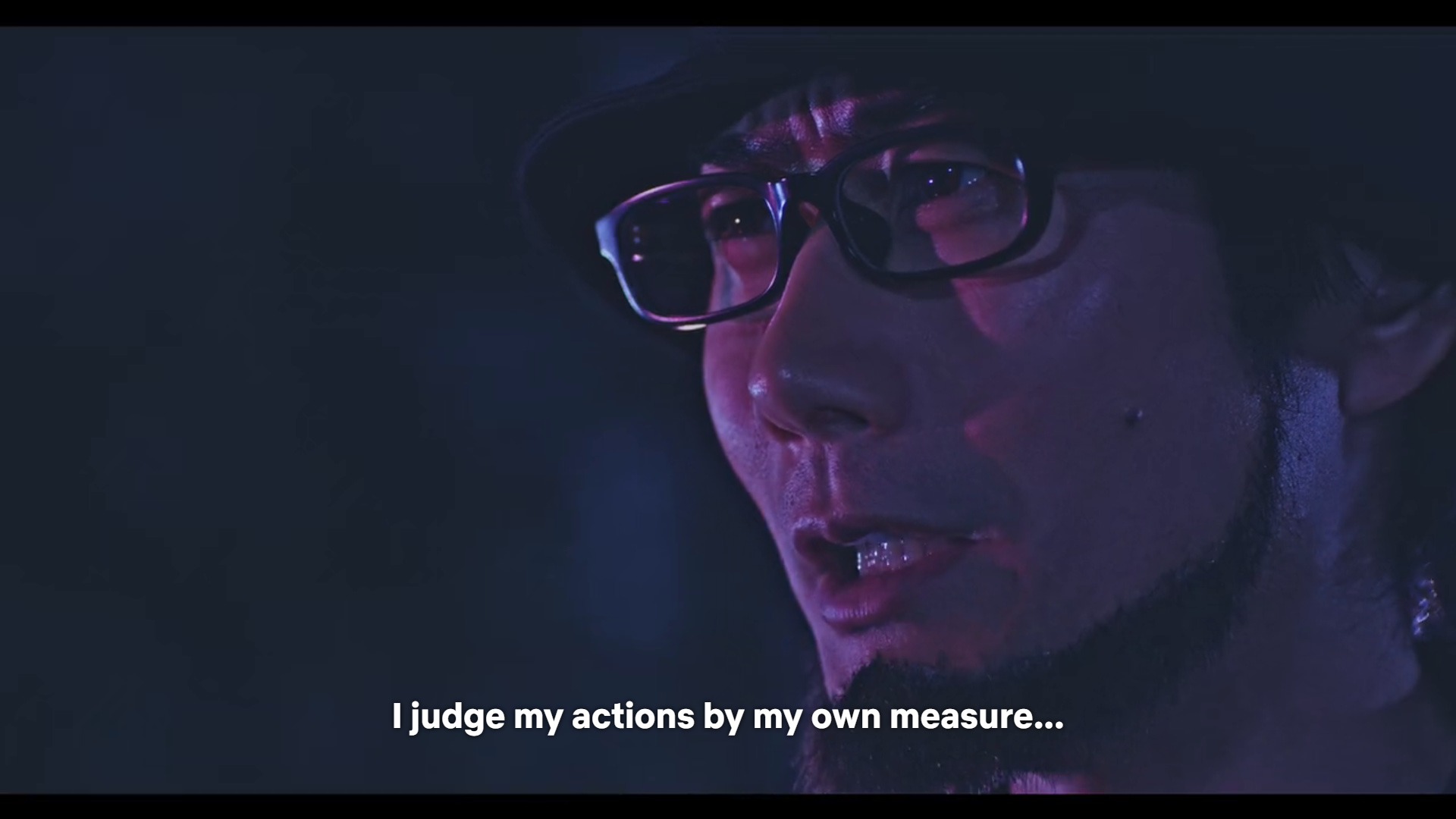
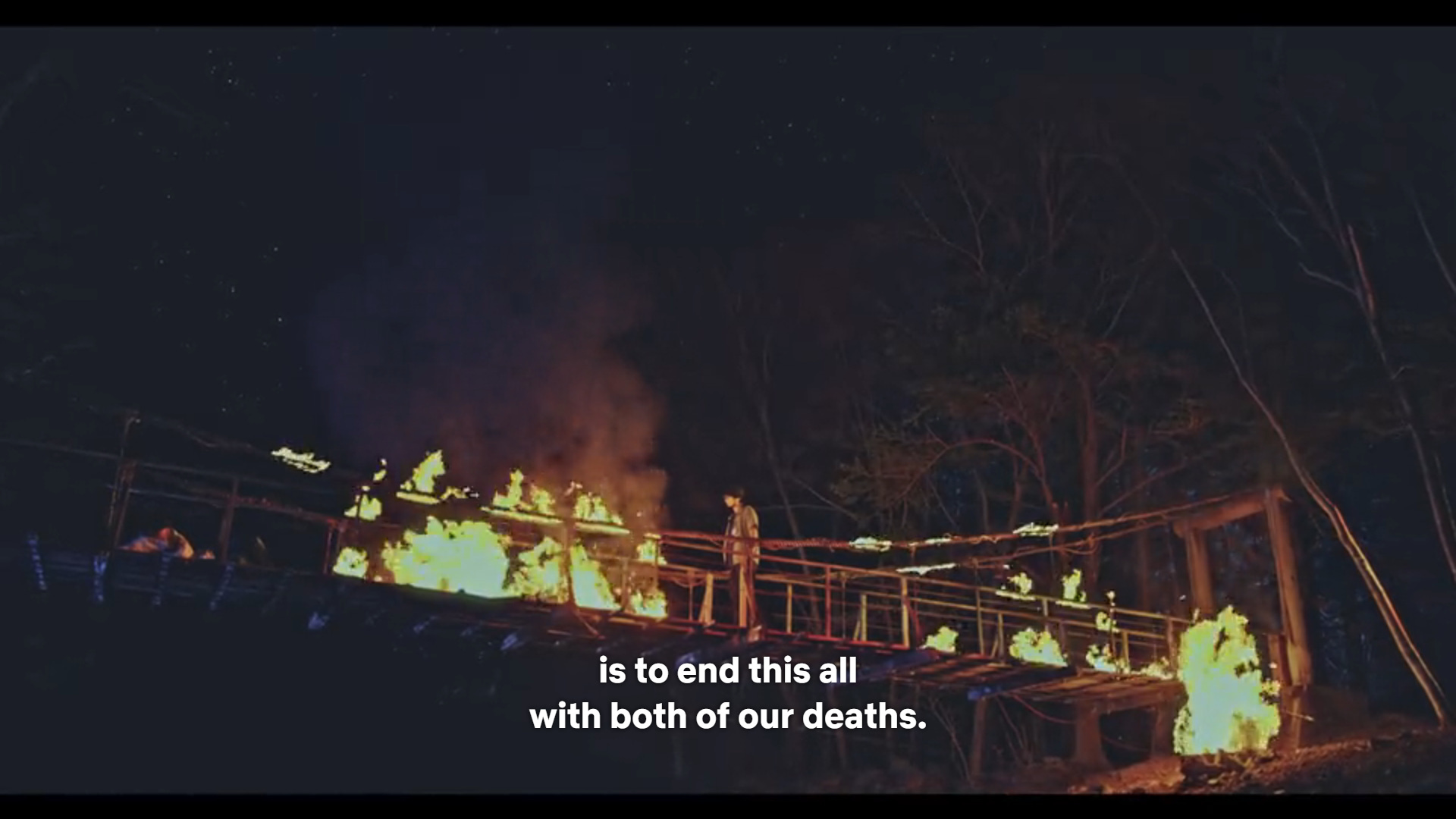
After that short detour, Yashiro has grown bored with the conversation. So he pulls out a small remote control and presses a button. There is an explosion, and the bridge bursts into flame.
As the world’s most fire-resistant wooden bridge burns merrily, Satoru takes the time to explain how he got here faster than Yashiro expected: human willpower defies medical explanation. And with that, he runs forward and tackles Yashiro over the railing into the river below!
This may be one of the most opaque finales I’ve done so far. What the heck is going on?!
As the two resurface and try desperately to tread water, floodlights suddenly open up on them. A small boat arrives and rescues Satoru. A woman embraces him when they reach the shore; Yashiro, too, has somehow reached the shore but I didn’t see how he got there.
Later, Yashiro is visited in prison. He explains to his visitor that he’s been “waiting for Satoru to wake up ever since”. Satoru was the only one who understood him, and ended up in a coma.
Odd. Satoru seemed perfectly fine when he got out of the river. How did he end up in a coma? Did the bridge scene take place many years prior, and Satoru since ended up in a coma for other reasons?
Yashiro then became a city councilman. Eventually, Satoru woke up, and Yashiro was elated: I don’t feel alone anymore. I wanted to kill Satoru, because he’s the only one I wasn’t able to kill.
Wait, what? Why does Yashiro want to kill the only person who understands him? And why didn’t he want to kill that same person while they were in a coma? What the hell is going on here?
A newspaper headline: Chiba serial murders, Nishizono sentenced to death.
Satoru, no longer on crutches, enters another man’s office. I can’t tell who this Kenya1 guy is; at first I think he’s a journalist, but then he says “we” charged Yashiro with multiple counts of murder, so maybe he’s a policeman. Multiple innocent people had been charged with Yashiro’s murders, so Kenya and Satoru are glad that the real culprit is finally in prison.
After Satoru leaves, Kenya pulls out a book of essays that he and his classmates had written in elementary school. Kenya’s essay says, “I will save the people I wasn’t able to.” How strange: how can you save somebody that you already failed to save? Aren’t they already dead? Or is this related to the time travel?
Later, Satoru is drawing a manga - possibly the original manga on which this series is based. He pulls out his own copy of that same book of essays, in which he as a child talks about his favorite manga, Wonder Guy, and its anime adaptations. Young Satoru wants to have friends just like Wonder Guy has, and also wants to grow up to write a manga of his own. Played under this voiceover are various clips of people, presumably from earlier in the series, but I don’t know who any of them are.
Return to the present: Satoru has succeeded in publishing a manga, called “World King of Flames”, and in his office is a poster for an anime that also has his name as author. He tells his coworkers that he’s stepping out for a bit. Just after he leaves a Mr. Urata rushes in, bringing two wine bottles to celebrate that Satoru’s work has been picked up for an anime (so I’ve clearly misunderstood the poster). It’s going to be the greatest anime of 2012, and Satoru is going to be rich!
A voiceover as Satoru wanders aimlessly through the city: “I haven’t experienced a Revival since I woke up. That must be because this is the real timeline.” His memories of the first timeline, where he was never in a coma, are starting to fade. So that’s a hint towards what type of time travel is used in this series. It’s what’s known in the fandom as a “Peggy Sue”: your consciousness returns to an earlier point in your life, memories intact, so you can make better choices.
He sits down under an overpass. There’s a young girl sitting there as well, and suddenly both of them are giving the same voiceover - something I don’t understand, about a city. Then the girl vanishes. Is that the same girl that Yashiro hallucinated before? What’s the connection between her and Satoru?
It’s begun to snow, and a woman takes shelter under the overpass, asking Satoru if she can join him. I’m guessing she’s his girlfriend in a previous timeline, because no other explanation is offered.
There’s a final voiceover: “The future has turned blank.”
Lingering questions
What?
I mean, seriously, what?
Okay, maybe I should try to figure this craziness out enough to ask coherent questions about it.
Will Satoru ever have another Revival?
Is the future turning blank a good thing or a bad thing?
Is Yashiro executed?
Ratings
There’s a standard disclaimer that I put here each week. You can read it at this footnote2, but it will do you no good. Even more than usual, this episode’s ratings should not be taken too seriously. For most finales I’m able to obtain at least some understanding of what’s going on. But this time I am so thoroughly bewildered that the ratings are a crapshoot at best.
Story: 3/10. The confrontation on the bridge was the only discrete event in the episode. I acknowledge that I’m almost certainly missing something, which is why I’m not giving this a 2, but it’s clear this was never intended to be a plot-focused finale.
Writing: 4/10. One of the more difficult scores to decide on. It’s hard to judge the quality of the dialogue and of the writing when you have no idea what’s going on - especially when so much of the runtime is devoted to descriptive voiceovers rather than to conversations. The few things I did understand weren’t very well handled - such as the “human willpower” and “society calls it evil” cliches.
The voiceovers, too, felt devoid of meaning - but with so little to go on, I’m not exactly confident in that assessment. Even more than most finales, I’m well prepared to be told just how badly I’ve missed the mark here (in either direction).
Production: 5/10. The production was perfectly fine. The acting was slightly above par; background music perfectly acceptable; very little to comment on, really.
The direction surrounding the moment where Satoru tackles Yashiro over the bridge railing was very effective; it was a genuine shock that made me sit up and take notice. But it’s rather counterbalanced by the bad staging of the fire.
Characterization: 5/10. Yashiro is a very interesting character. So far as I can tell, he is a serial killer who desperately wants someone to understand him - yet also wants to murder the one person who can, just because he’s the one who got away. I’m interested in delving deeper into that worldview.
Satoru is a bit of a nonentity, as is Kenya, and I didn’t even get anybody else’s names.
Accessibility: 0/10. I didn’t think anything could compete with John From Cincinnati’s final episode for sheer incomprehensibility, but this finale has managed it. And while JFC is victorious in the category of “most opaque dialogue”, I think Erased might actually have it beaten overall. Here are a few of the reasons:
I can’t tell if the episode as presented is linear or non-linear.
I can’t even tell if all of the scenes in the episode take place in the same timeline.
Some of the characters in John From Cincinnati were normal humans trying to grapple with strange circumstances. It doesn’t feel as bad if the people on the screen are just as confused as you are.
The mysteries abound: What are Revivals? How do they work? What triggers them? How does Satoru know he won’t have another one? What are these different timelines that he mentioned - one where he is in a coma, one where he isn’t, and so on? What’s the connection between them and this random serial killer? What’s with the note in the girl’s backpack? What’s with the vanishing girl on the bridge and under the overpass? Who is Satoru’s girlfriend?
Closure: 8/10. This is obviously guesswork, given how little I understood. It looks like the series reached a natural conclusion, with all the time-travel shenanigans permanently ended and the villain of the piece locked up and waiting execution. But given the questions I listed in the last paragraph, for all I know there are a million things left unresolved.
Do I want to watch the series now?
Are you kidding me? I don’t have a clue!
Is there a series finale you’d like me to try? Join our Discord or leave a comment below.
His name is given later in the scene; for convenience I’ll start calling him that now.
The standard disclaimer reads as follows:
I evaluate the finale-of-the-week from an angle that its writers never intended: how well it works as an individual episode watched in isolation. This will likely differ greatly from how the episode works in its proper context. And it should go without saying that the following does not apply to the series as a whole, which I have not watched.
The rating system is from 0 to 10, where 5 is considered average for television. These are intended to be measurements, not judgements; high ratings are not necessarily better and low rating are not necessarily worse. For example, a strong character piece may have no plot, or a finale may intentionally provide no closure - neither of which makes an episode bad.