
Serial Experiments Lain
“Ego”, Season 1 Episode 13

Requested By
jakkdl on our Discord server
What do I know about this series going into it?
I had heard of it prior to the request, but knew nothing about it. Through glimpses of text while clicking through to begin streaming, I saw that “Lain” is the name of a character and that she was created as the result of genetic experiments. I may be getting that slightly wrong.
Recap
Note: When I watch a non-English series, I always watch the subtitled rather than the dubbed version. The original language’s voice acting is always of higher quality, and the subtitles teach me how to spell unfamiliar names. But in this case only the dub was available for purchase, and subtitles were not available at all.
A girl appears on a television screen. She is confused: she doesn’t know if she is here, there, or everywhere or nowhere. Then she gets even more philosophical: I only exist inside people who are aware of me, but I am aware of myself, and I can hear myself speaking, so who is the ‘me’ that is speaking, etc.
The opening credits show a little bit of the story. I’m extrapolating and guessing from brief moments, but I think this character is virtual, existing only inside a television. A boy found out about her and befriended her, but she is jealous of his relationship with a real-world girl. There are crows.
The title of the episode comes up. It is spelled Ego, but pronounced Eggo. Like the waffles.
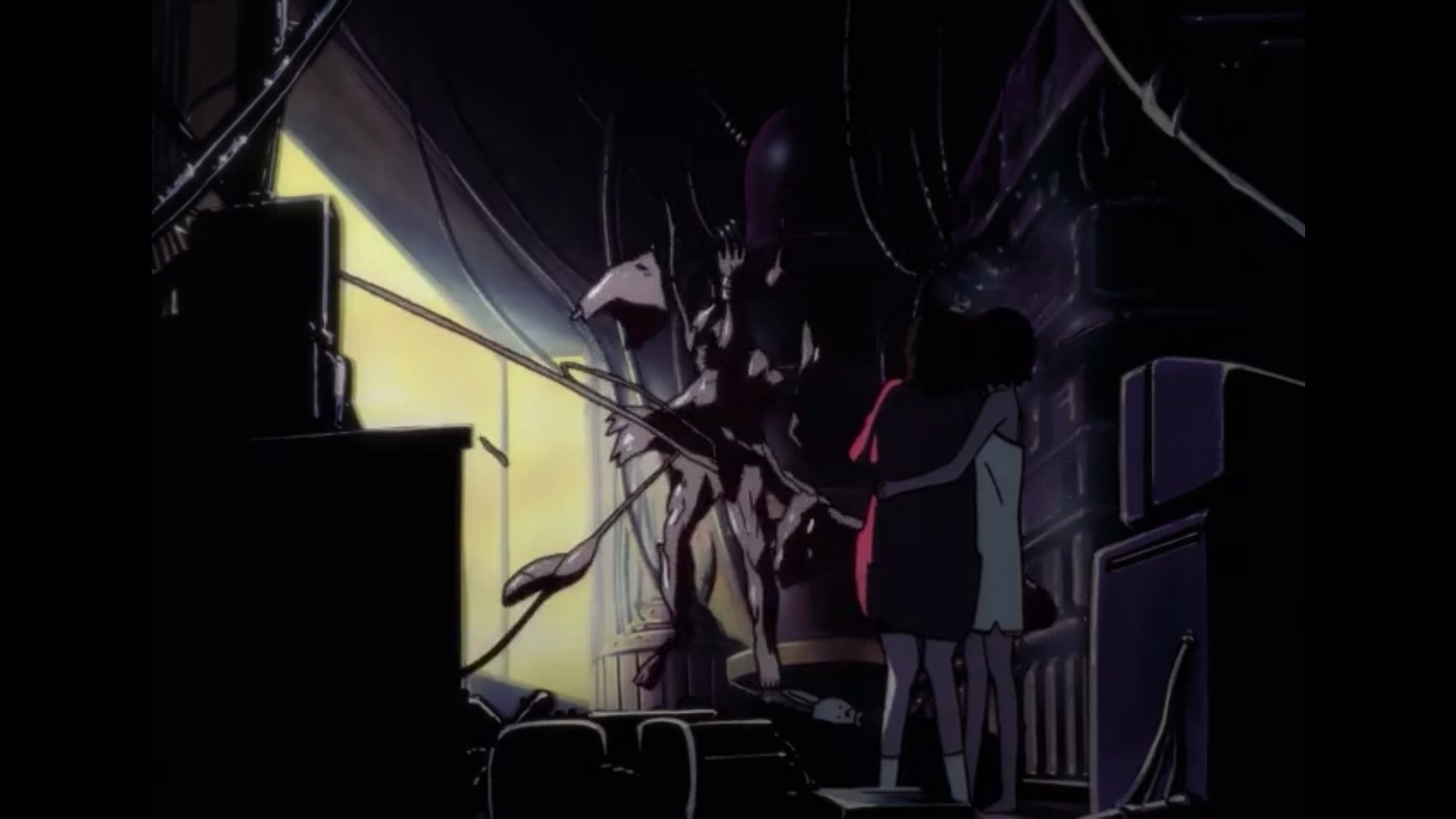
Back to the episode proper. A goo monster coalesces and extends a tentacle to grab two women, one of whom is screaming in panic. The other woman seems to use magic powers to smash the goo monster with metal boxes, then taunts it: “You still think having a body doesn’t mean anything to you?”
The goo monster thus defeated, the younger woman apologizes to the older, whose name is Alice: “I mess up everything I try to do for you.” Alice, however, is nearly catatonic with fear and still freaking out.
Text appears on screen: All Reset Return. In the background behind the text, I can see various events happening in reverse. Are we going back in time? Was this a simulation of the future that ended badly and we’re restarting the simulation?
A door opens in midair. Nobody comes in or out; instead, we get a close-up of food on a table as voices discuss the meal. At first I think there are three voices, a father and a mother and a girl, but when we eventually zoom out the only people at the table are two adults. Did I mishear? But the father keeps looking at an empty chair beside the table, as if expecting someone to be there.
In the overheard conversation, the child (if there is one) doesn’t want to finish eating, because she’s on a diet, and the father asks the mother to pay for a package of computer parts when it arrives.
We see other parts of the world outside: a train, power lines. But the world is oversaturated. The sky is bright white and nonexistent.
Focus on a school, on Alice as a child. Her friends want to go out tonight, to Siberia1. She wants to invite somebody else – another girl with glasses that she looks at meaningfully – but her friends object.
Alice suddenly realizes something: If you aren’t remembered, you never actually existed. I don’t understand the connection to what they were just talking about, though. Has Alice suddenly received partial memories of that future timeline, and has now altered history by not inviting Chisa this time?
Elsewhere, a boy named “Totto” opens his phone.
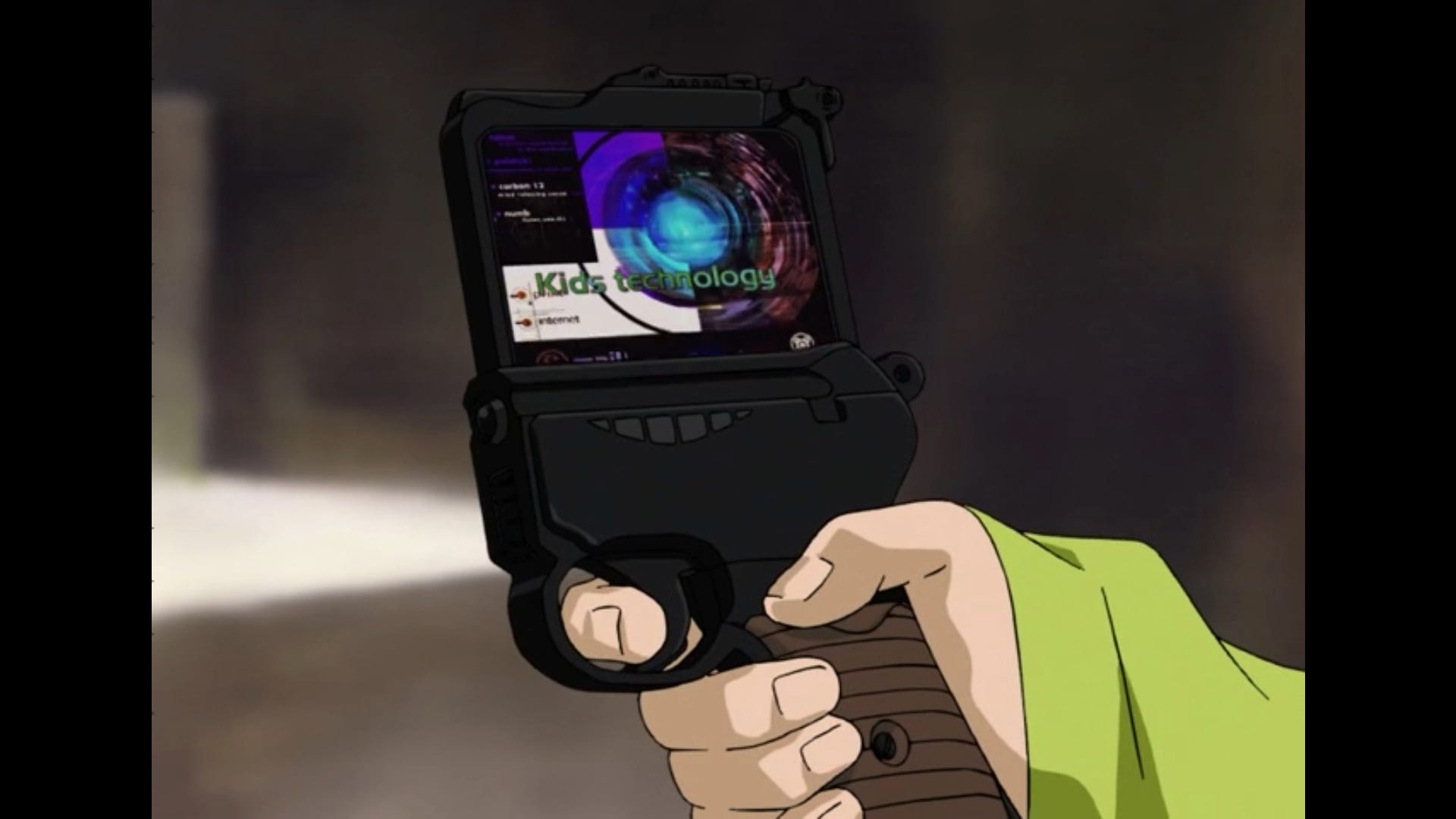
The virtual girl from the opening briefly appears on the screen, then fuzzes out. Totto stares at it, transfixed, until his girlfriend calls him. He eventually puts the phone away. My guess is that in the original history this was when he and the virtual girl met, but in this altered timeline she has decided not to speak to him.
As Totto and his girlfriend walk off, they pass a muttering man with an “I’ll show them all” kind of attitude. The man looks meaningfully at some workers replacing a power line, then decides to move on.
Text appears: “What isn’t remembered never happened. Memory is a record. You just need to rewrite that record.”
Maybe we didn’t time travel, and maybe the first scenes weren’t a simulation? It seeems the girl from the opening is rewriting people’s memories of what happened. Totto really did stay and talk to the virtual girl; the muttering man really did do who-knows-what with the power lines; and Chisa really did go with Alice to Siberia. But none of them remember it, so it’s as if it never happened.
That would explain the oversaturation and the bright white sky. You remember what happened around you on a given day; you don’t remember the cloud pattern if it wasn’t relevant. The sky just isn’t part of your memory of the event, so when the girl accesses those memories to rewrite them the sky is just a white void.
A cackling man announces, “Present day, present time”. The sky looks normal. A woman stands in the middle of a street, in the fog.
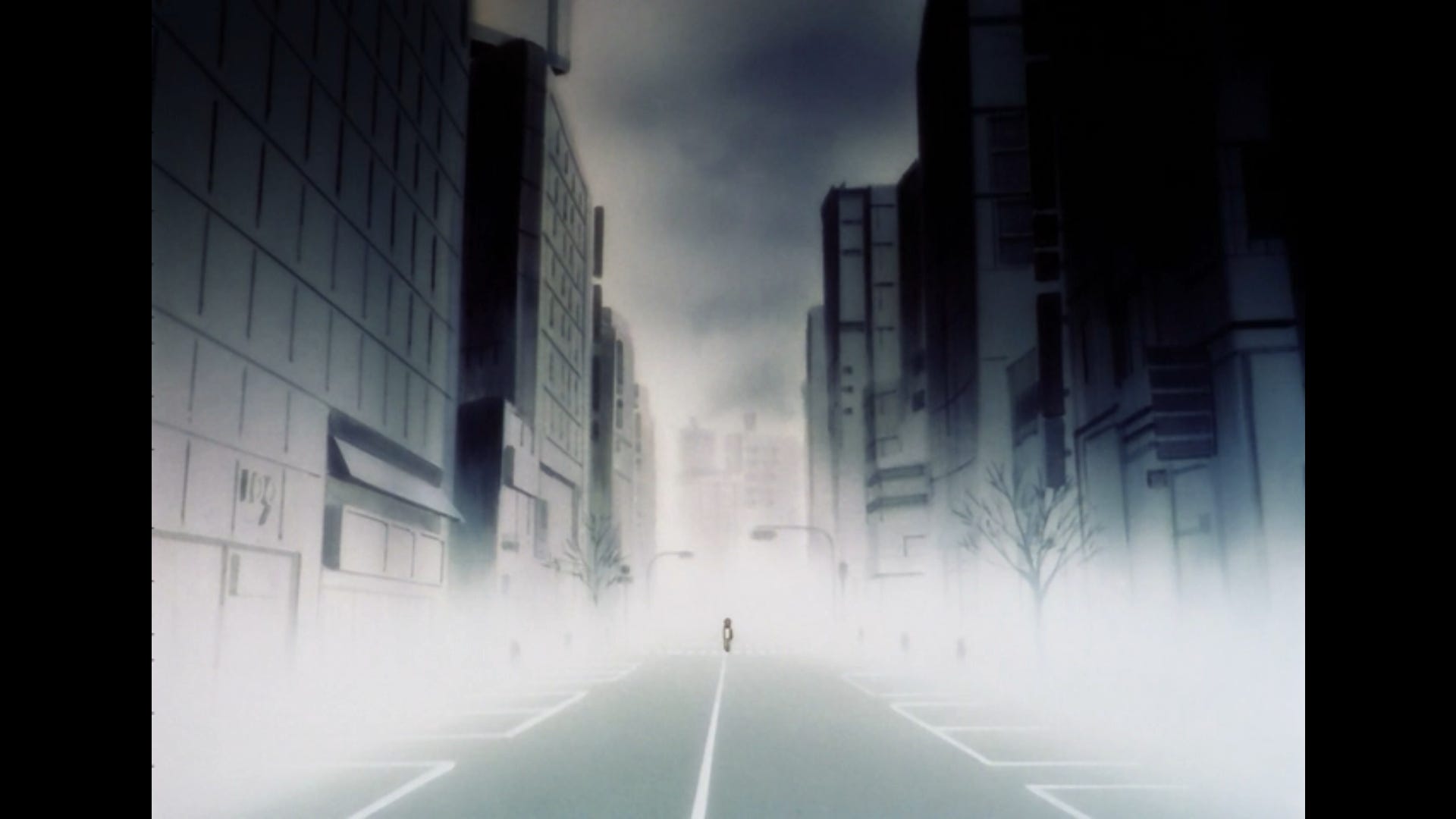
A voice calls out to her: “Why are you crying, Lain? Because you deleted yourself from everyone’s memory?”
The speaker, another woman, fades into existence beside Lain. But she has the same hairstyle, so I think this might be an alternate version of her or perhaps her own subconscious. “This is what you wanted,” says AlterLain. “Nobody is dying in strange ways anymore, ‘he’ doesn’t want to be God anymore, you don’t need to be anywhere anymore, nobody hates you.”
“So where am I now that I don’t exist?” asks Lain, having established that this is what happens to you if you are not in anybody’s memories.
She’s in “The Wired”, Lain and her subconscious explain to each other. The Wired, if I understand this correctly, is some kind of technological development that allowed humanity to store its collective subconscious – or so its creators thought. But Lain can’t believe that humans could have created such an enormous storage space. What it actually did was give humanity access to the already-existing collective subconscious that is a natural part of the universe. And since Lain exists there (and only there), she can perceive everything and is present everywhere. “Does that make Lain God?” AlterLain wonders.
But Lain isn’t very happy with this. So AlterLain has another recommendation: reset things again, reinsert yourself in everybody’s memories, go back to the way things were. “Enough!” Lain shouts, and breaks down crying.
“Come, Lain,” says a man’s voice, which she recognizes as her father’s2.
They sit together at a table in the sky. Lain says she loves everyone, and cries again. I wonder if her “father” is actually God.
Alice, walking through a city with her SO, sees Lain as a young girl on a pedestrian bridge. She recognizes her as someone she may or may not have met before. They talk for a little bit and then say goodbye. I don’t understand the significance of this scene either, but I think it’s another alteration of a scene that played out differently in the original memory (or original history, or what-have-you).
Finally, Lain reappars on a television screen and promises you – the viewer? – that she will always be there, next to you, forever.
Unresolved questions
How long will Lain be content with her omniscient, omnipresent, yet non-omnipotent existence? Will she meddle in human affairs again?
Is Alice’s life truly better without Lain’s intervention?
Considering Lain clearly intends to do good, which of the evil things that happened in the original timeline (such as a goo monster) will still happen, only without Lain there to stop them?
Lain’s subconscious mentioned that people aren’t “dying in strange ways anymore”, implying that people did die in the original timeline. If all she’s doing is altering people’s memories – not altering the actual events – does that mean everyone else remembers those dead as being still alive? What happens when discrepancies between people’s memories and reality start to get noticed?
Ratings
These ratings evaluate the finale-of-the-week from an angle that its writers never intended: how well it works as an individual episode watched in isolation. The analysis accompanying each rating is written from that point of view as well.
The ratings do not necessarily apply to the episode if it is watched in the proper context. And it should go without saying that none of them apply to the series as a whole, which I have not watched.
Story: 4/10. As far as I could tell – and I acknowledge it was extraordinarily difficult to understand – this episode didn’t have a story. At least, not in the sense of “a sequence of events that form a plotline”.
That's at least partially, if not entirely, by design. Once Lain decides to remove herself from humanity’s memories, most of the episode comprises a series of scenes in which very deliberately nothing happens. So the low story rating in this case is not meant as a criticism.
The opening scene, with Alice and Lain and the goo monster, was the only event of consequence. I don’t understand why this event of all things – especially seeing as Lain defeats the goo monster – is what leads Lain to decide that enough is enough. But I can readily imagine several reasons, so that isn’t a criticism either.
Writing: 8/10. I fundamentally disagree with the premise that things only exist if they are present in memory. Unless Lain is prepared to continuously rewrite people’s memories, they will regularly encounter discrepancies between the real world and the one they thought they were living in.
“Reality is that which, when you stop believing in it, doesn’t go away.”
– Philip K. Dick
Just because Alice remembers living a wonderful life with (let’s say) her husband doesn’t mean she actually has food in the fridge, clothes in the closet, photographs on the walls, and signatures on her apartment’s property registry certificate in the local Legal Affairs Bureau3. What happens when she and her husband come home to the life they thought they were living, and finds it fully stocked with someone else’s stuff4?
And it’s not just Alice; there are probably dozens of people who might have injuries they don’t remember receiving; missing loved ones they don’t remember dying; Siberia receipts in their wallets they don’t remember paying for; footage on surveillance cameras that doesn’t match what they think happened.
That said, disagreeing with the theme is not a criticism of its presentation. And while I’m not a fan of extended philosophical perorations, this episode’s was better done than most.
Similarly, the sequence of scenes in which very deliberately nothing happens could have come across as boring in the wrong hands. In this case, however, they were very clearly in the right hands. I was riveted.
Production: 3/10 or 6*/10. I hate dubbed anime, and always have. There is something about how American voice actors approach it that makes them sound ridiculously overenthusiastic. I’ve never understood why this is the case, because other American voice actors - sometimes even the same ones - do perfectly fine jobs when voicing other works. I would not have watched the dubbed version if I had had the choice.
The unavailability of the original isn’t the episode’s fault, however, so I am giving two production ratings. The 3/10 applies to the dubbed version that I watched; the 6*/10 applies to a theoretical subtitled version, assuming the original Japanese voice acting is of average quality. The asterisk is there to convey that I don’t actually know how good that voice acting was, so feel free to adjust it as you like by two or three points in either direction.
The animation had its high and low points. On the negative side, there was blatant use of slow panning over still frames to save money. But that was outweighed by the excellent use of blinding white to signify the blind spots in people’s memory. The door opening into nowhere: Who pays attention to the ground underneath a door as you walk through it? The walkways in the city: Who pays attention to the specific brick patterns you walk over as you’re talking to your friends? The sky above the buildings: Who looks up unless they have a specific reason to?
I at first recoiled from the style, but grew to appreciate it as soon as I realized what it was all about.
Characterization: 5/10. There was only one character in this episode: Lain. We had the barest glimpse at Alice, but everybody else was a nonentity. That said, the exploration into Lain’s unique existence and psychology was very well done. The depth of that one character balances out a horde of unknowns, enough to give this an average rating.
Accessibility: 3/10. Oh God. I think by the very end I understood the basics, but there is just too much I don’t know. All of the characters, of whom I had only brief glimpses; the vanished events of the original timeline, and the reason Lain was so desperate to undo them; what The Wired is all about; and so on.
Even the parts I thought I understood aren’t entirely clear. For all I know, Lain does in fact have the power to rewrite the physical universe, thus making my criticisms of a memory-based reality moot.
Closure: 8/10. Really this deserves a 9/10, as Lain’s story concludes and she settles into her role as a sort of God. I took an extra point off because of the plot holes in the universe that will probably arise, as previously described.
Do I want to watch the series now?
It’s hard to tell, because the entire point of this episode is to show what the series would have been like if nothing happened. And that doesn’t tell me what did happen. A world war? A romantic comedy? An alien invasion? A chess tournament? A zombie apocalypse? Other than that one goo monster (of whom I only caught the briefest glimpse, and that before I had any grasp of the setting) I don’t have the slightest clue what the show’s genre was.
That said, if the writing quality is up to par with this episode, I’m definitely interested.
That famous teenage hangout destination. Everyone loves a nice gulag after school!
(More seriously, though, it’s probably the name of a local ice cream store or some such.)
If she is a virtual person, I assume this refers to her creator.
Which will cause them a massive bureaucratic problem if they ever try to sell it.
Not to mention, what happens when that someone else tries to go to the apartment they think they own, and finds yet another someone else’s stuff… and what happens when that yet another someone else goes to etc. etc.…